
Coco Peat Sourcing in India: What Buyers Need to Know
India is an important sourcing destination for coco peat because of its strong coconut-processing and coir industries.
For nurseries, greenhouse growers, hydroponic farms, commercial agricultural businesses, distributors, and exporters, choosing reliable coco peat manufacturers in India is important for maintaining consistent product quality and dependable bulk supply.
Coco peat is a natural growing medium obtained from coconut husks. It is widely used for seed germination, nursery cultivation, greenhouse farming, hydroponics, potting mixes, and other commercial growing applications.
However, coco peat products can differ in EC, pH, moisture content, particle size, expansion volume, washing, buffering, and overall quality. Therefore, buyers should compare manufacturers based on product specifications and supply capabilities rather than price alone.
This guide explains how coco peat is manufactured, the different products available, where to source coco peat in India, how to compare suppliers, what affects wholesale prices, and what buyers should check before placing a bulk order.
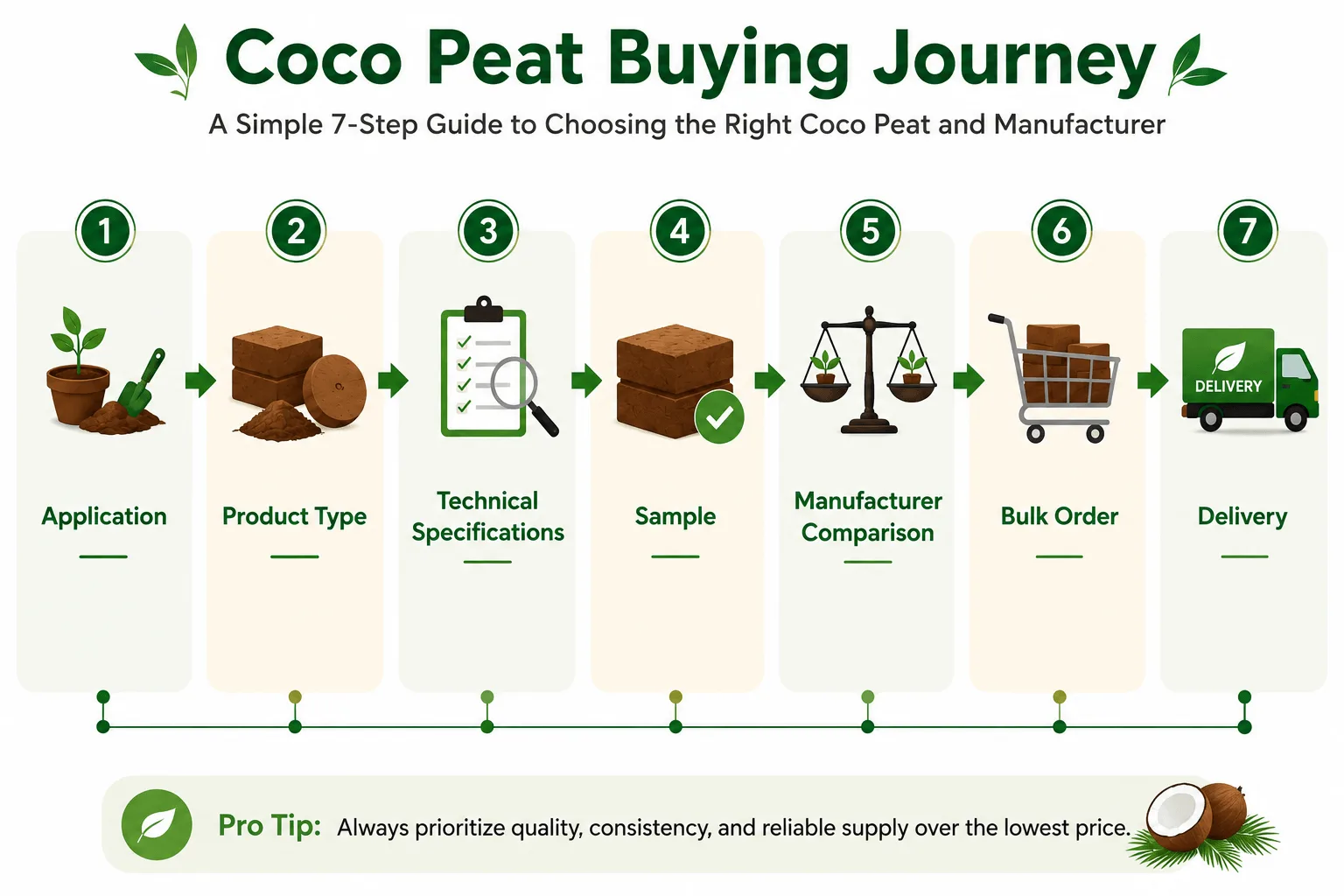
Coco Peat Buying Journey
What Is Coco Peat?
Coco peat is a fine, natural material obtained during coconut husk processing. When coconut husks are processed for coir fibre, the finer pith-like material is separated and processed into coco peat.
It is widely used as a growing medium because of its moisture-retention and aeration characteristics.
Key Characteristics of Coco Peat
- High water-holding capacity
- Good aeration
- Lightweight
- Renewable and natural origin
- Suitable for seed germination
- Useful for nursery cultivation
- Suitable for greenhouse growing
- Used in hydroponic and soilless systems
- Available in different grades and particle sizes
- Can be compressed for efficient transportation and storage ----->
The ideal coco peat specification depends on the crop, growing system, irrigation method, and intended application.
How Is Coco Peat Manufactured?
Understanding the manufacturing process helps buyers evaluate product quality and consistency.
1. Coconut Husk Collection
Coconut husks are collected from coconut-processing activities and used as the raw material for coir and coco peat production.
2. Fibre Separation
The husks are processed to separate longer coir fibres from shorter fibres and finer pith-like material. This fine material forms the base of coco peat.
3. Processing and Screening
The material is processed and screened to remove unwanted particles and achieve the required particle structure.
4. Washing and Buffering
Depending on the intended application, coco peat may be washed to reduce soluble salts. Some products may also undergo buffering for specific growing requirements.
5. Drying
The processed material is dried to achieve the required moisture level. Proper moisture control is important for storage, handling, and transportation.
6. Compression
Coco peat can be compressed into blocks, briquettes, discs, or other formats. Compression significantly reduces storage and transportation volume.
7. Packaging
The finished product is packed according to the customer's requirements, including domestic, commercial, retail, or export packaging.
How to Choose Reliable Coco Peat Manufacturers in India
Not every manufacturer produces coco peat with the same specifications. Before choosing a supplier, buyers should evaluate the following factors.
Check EC and pH
Electrical conductivity (EC) is an important parameter because soluble salts can affect sensitive crops.
Buyers should request the manufacturer's product specifications and quality reports where available.
pH is also important because growing-medium characteristics can influence nutrient availability and crop performance.
Check Expansion Volume
For compressed coco peat blocks, weight alone does not indicate how much usable growing medium the product will provide.
Compare the expected expanded volume and make sure manufacturers use comparable measurement conditions.
Evaluate Moisture Content
Moisture affects product weight, transportation cost, and storage conditions.
Ask the manufacturer for the specified moisture range before comparing quotations.
Check Particle Size
Particle structure affects water retention, drainage, and aeration.
Depending on the application, buyers may require fine, medium, or coarse material.
Check Washing and Buffering
Ask whether the coco peat is washed, buffered, or supplied in another specific condition.
The correct specification depends on the crop and growing system.
Request a Sample
Before placing a large order, request a sample whenever possible.
Evaluate:
- Expansion
- Water retention
- Drainage
- EC
- pH
- Moisture
- Particle structure
- Physical consistency
Coco Peat Manufacturers vs Suppliers vs Exporters
These terms can represent different roles in the supply chain.
Coco Peat Manufacturers
Manufacturers process coconut-derived raw materials and produce coco peat products. They may supply directly to farms, nurseries, distributors, retailers, and exporters.
Coco Peat Suppliers
Suppliers source and distribute coco peat to customers. Some suppliers operate processing facilities, while others work primarily as distributors or trading companies.
Coco Peat Exporters
Exporters focus on international orders and may handle export packaging, documentation, container loading, shipping coordination, and destination-market requirements.
For bulk purchases, buyers should confirm whether they are dealing directly with the manufacturer or through an intermediary.
Types of Coco Peat Products
Indian manufacturers may supply coco peat in several formats.
Coco Peat Product Forms
🧱 Blocks → 🌱 Grow Bags → ⚪ Discs → 🪴 Loose Coco Peat
Request a Sample
Compressed coco peat blocks are convenient to transport and store. After hydration, they expand into loose growing media suitable for nurseries, greenhouse cultivation, farms, and other applications.
Coco Peat Grow Bags
Grow bags are commonly used for greenhouse and protected cultivation. They can be supplied in different dimensions and specifications depending on the crop and growing system.
Coco Peat Discs
Compressed discs are compact and convenient for seed starting, nursery applications, home gardening, and smaller growing requirements.
Loose Coco Peat
Loose coco peat can be supplied for customers who require larger quantities for direct use or blending.
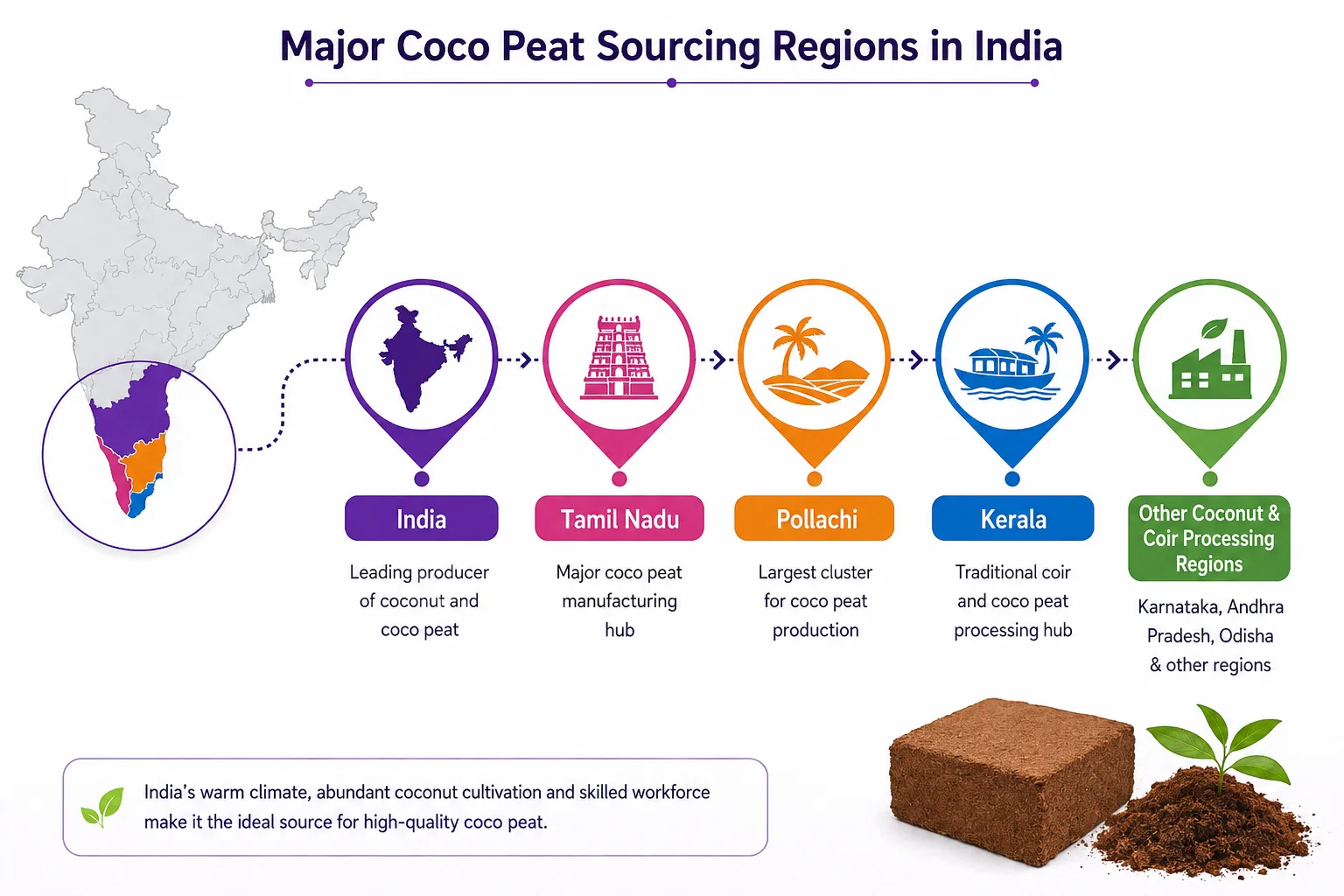
Major Coco Peat Manufacturing Regions in India
Coco peat production is closely connected with India's coconut-growing and coir-processing industries.
Coco Peat Manufacturers in Tamil Nadu
Tamil Nadu is an important region for coconut and coir-related industries. Pollachi and surrounding areas are particularly well known for coconut processing.
When comparing coco peat manufacturers in Tamil Nadu, buyers should consider:
Production capacity
Product specifications
Raw-material sourcing
Processing methods
Quality testing
Packaging
MOQ
Delivery capability
Coco Peat Manufacturers in Kerala
Kerala is another major coconut-producing and coir-processing region.
Buyers looking for coco peat manufacturers in Kerala should compare processing capabilities, product quality, available formats, production capacity, packaging, and bulk-order capabilities.
How to Buy Coco Peat in Bulk
Before requesting quotations, clearly define your requirements.
1. Define the Application
Tell the manufacturer whether the coco peat will be used for:
- Seed germination
- Nurseries
- Greenhouse cultivation
- Hydroponics
- Potting mixes
- Commercial farming
- Distribution
- Export
2. Select the Product Format
Specify whether you require blocks, grow bags, discs, or loose coco peat.
3. Define Technical Specifications
Specify your requirements for:
- Weight
- Expansion volume
- EC
- pH
- Moisture
- Particle size
- Washing
- Buffering
4. Request a Sample
Test the product before committing to a large order.
5. Confirm MOQ and Capacity
Ask about the minimum order quantity and whether the manufacturer can consistently supply your required monthly or quarterly volume.
6. Compare Quotations
Compare quotations based on the same product specifications.
7. Confirm Packaging and Delivery
Discuss packaging, delivery timelines, transportation, and export requirements before confirming the order.
Coco Peat Wholesale Price: What Affects the Cost?
The coco peat wholesale price can vary according to product specifications, processing requirements, quantity, packaging, and transportation.
Important factors include:
- Product weight
- Expansion volume
- EC
- pH
- Moisture content
- Washing
- Buffering
- Particle size
- Compression
- Packaging
- Order quantity
- MOQ
- Transportation
- Delivery location
- Domestic or export requirements
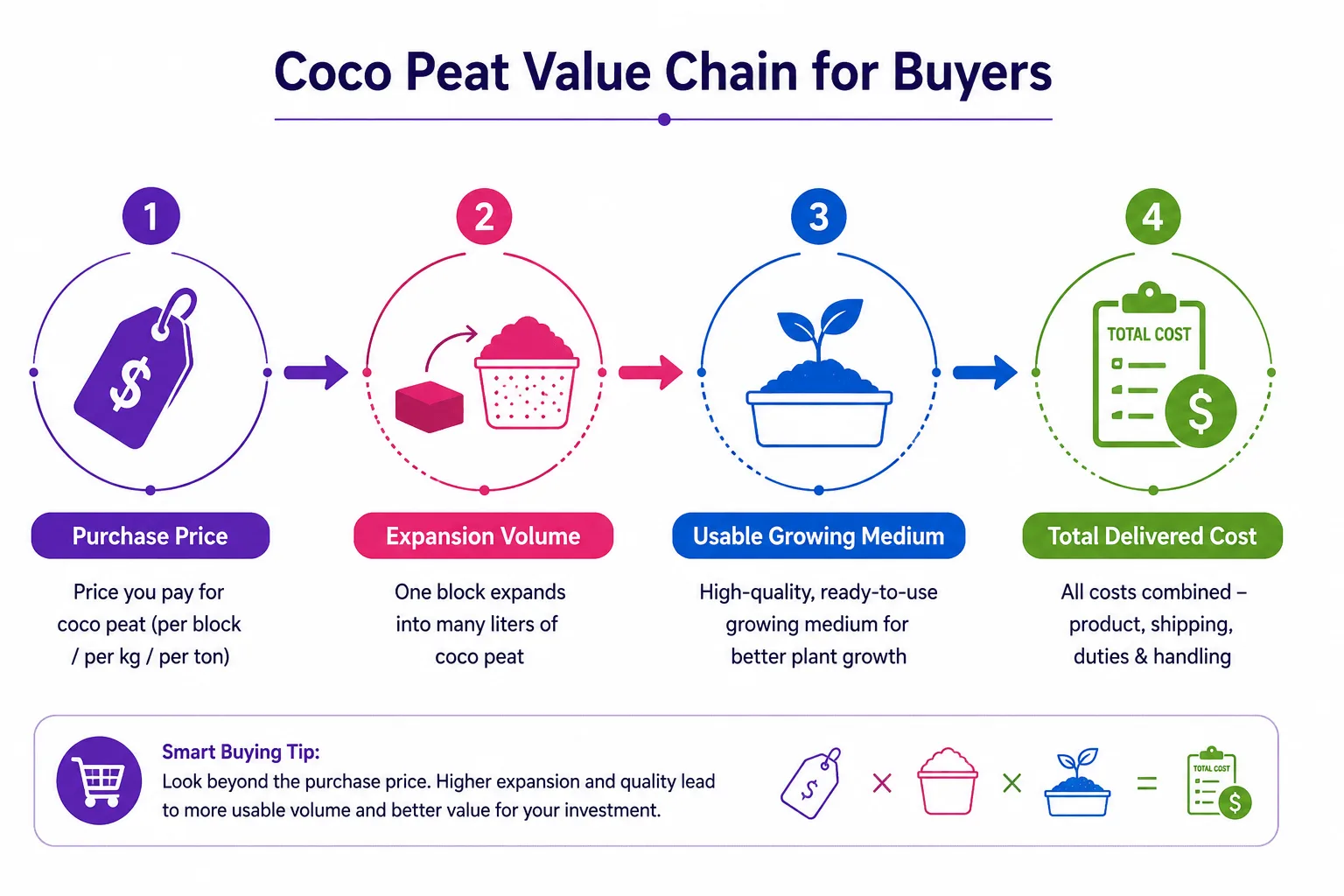
Buyers should not compare prices based only on the cost per block or kilogram.
A better approach is to compare the cost against usable expanded volume and required product quality.
Example
If two blocks have the same nominal weight but different expansion volumes, the cheaper block may not necessarily provide better value.
Therefore:
How to Compare Coco Peat Suppliers
When comparing coco peat suppliers, request the same specifications from every supplier.
|
Specification |
What to Check |
|
Product type |
Block, grow bag, disc, or loose |
|
Weight |
Net weight per unit |
|
Expansion |
Expected expanded volume |
|
EC |
Product EC specification |
|
pH |
Product pH range |
|
Moisture |
Moisture percentage |
|
Particle size |
Fine, medium, or coarse |
|
Washing |
Washed or unwashed |
|
Buffering |
Buffered or non-buffered |
|
Packaging |
Packaging type and size |
|
MOQ |
Minimum order quantity |
|
Lead time |
Production and delivery time |
|
Testing |
Available quality reports |
|
Shipping |
Domestic or export arrangements |
Using the same specifications for every quotation makes supplier comparison much easier.
Coco Peat for Export Markets
Indian coco peat exporters supply products to agricultural and horticultural markets internationally.
Compressed coco peat products can be useful for export because compression reduces transportation and storage volume.
Export buyers should confirm:
- Product specifications
- EC
- pH
- Moisture
- Expansion volume
- Packaging
- Container loading
- Documentation
- Shipping terms
- Destination-country requirements
Technical requirements should be agreed upon before production begins to avoid quality or specification issues later.
Questions to Ask a Coco Peat Manufacturer
Before placing a bulk order, ask:
- What is the exact product specification?
- What are the EC and pH levels?
- What is the moisture percentage?
- What expansion volume can I expect?
- Is the product washed or buffered?
- What particle sizes are available?
- What is the MOQ and production capacity?
- Can you provide samples and quality test reports?
These questions help buyers compare manufacturers more effectively.
Frequently Asked Questions
1. What is coco peat used for?
Coco peat is commonly used for seed germination, nurseries, greenhouse cultivation, hydroponics, potting mixes, and commercial farming.
2. How do I choose the right coco peat manufacturer?
Compare EC, pH, moisture, expansion volume, particle size, processing, quality testing, production capacity, MOQ, packaging, and delivery capabilities.
3. What determines coco peat wholesale price?
Price depends on specifications, weight, expansion volume, processing, packaging, quantity, transportation, and delivery requirements.
4. Can Indian manufacturers supply coco peat for export?
Yes. Indian manufacturers and exporters can supply coco peat blocks, grow bags, discs, and other formats to international buyers, subject to product and destination requirements.
5. Can coco peat be used for hydroponics?
Yes. Coco peat is widely used in soilless and hydroponic growing systems. The appropriate specifications depend on the crop and growing system.
6. Can I request a sample before a bulk order?
Yes. Requesting a sample before a large purchase is a useful way to check whether the product meets your technical and application requirements.
Conclusion
Choosing the right coco peat manufacturers in India is important for farms, nurseries, greenhouse growers, distributors, and exporters.
Instead of comparing manufacturers based only on price, buyers should evaluate product specifications, EC, pH, moisture, expansion volume, particle size, processing, packaging, production capacity, and delivery reliability.
India's established coconut and coir-processing industry provides buyers with multiple sourcing opportunities. Whether you are looking for coco peat blocks, grow bags, discs, or bulk growing media, a clear specification and structured supplier comparison can help you make a better purchasing decision.
For bulk buyers, the ideal process is simple:
Define requirements → Request samples → Verify specifications → Compare manufacturers → Confirm commercial terms → Place the bulk order
Looking for a Reliable Coco Peat Manufacturer in India?
Greglo supplies coco peat solutions for growers, nurseries, distributors, exporters, and agricultural businesses.
Whether you need coco peat blocks, grow bags, discs, or other formats, you can discuss your required specifications, quantity, packaging, samples, and delivery requirements with the Greglo team.