
Understanding Coco Peat Prices in India
Coco peat is widely used as a growing medium in nurseries, greenhouse cultivation, hydroponics, seed starting, horticulture, and commercial farming.
As demand for soilless growing media continues to increase, buyers often compare coco peat price based on product weight, block size, quality, expansion capacity, and order quantity.
However, the price of coco peat is not determined by weight alone. Processing methods, EC level, moisture content, particle size, compression, packaging, and transportation can all influence the final cost. A lower-priced block may not always provide better value if it has lower expansion capacity or does not meet the required specifications.
For buyers looking for compressed coco peat products, two common formats are 650g cocopeat bricks and 5kg cocopeat blocks.
Understanding the difference between these formats and the factors affecting their pricing can help you choose the right product for your application and quantity requirements.
Coco Peat Price in India: What Determines the Cost?
The cost of coco peat can vary depending on how the product is processed, compressed, packaged, and supplied. Retail quantities generally have a different price structure from wholesale orders, while customized specifications can also affect the quotation.
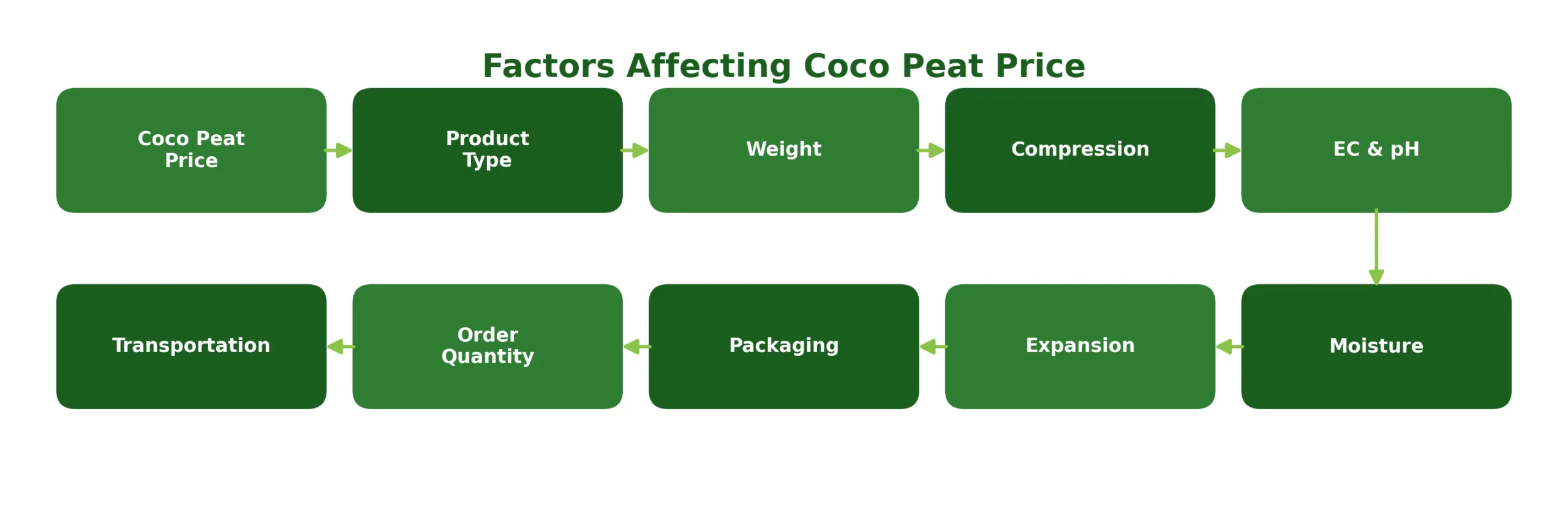
Some of the major factors affecting coco peat cost include:
- Product weight and format
- Compression level
- Expansion capacity
- EC level
- pH
- Moisture content
- Particle size
- Washing and buffering requirements
- Packaging
- Order quantity
- Transportation and delivery location
When comparing quotations, buyers should therefore look beyond the price of a single brick or block.
Purchase Price → Product Specifications → Expansion Volume → Usable Growing Medium → Delivered Cost
Factors Affecting Coco Peat Price
Coco Peat Price Per Kg
Comparing coco peat price per kg is one of the easiest ways to evaluate different product quotations. The basic calculation is:
Price Per Kg = Total Product Price ÷ Net Product Weight
For example, if a buyer receives a quotation for a 5kg block, the total price can be divided by 5 to determine the approximate price per kilogram.
However, price per kg should not be the only comparison point. Two coco peat products with the same weight can provide different value depending on their quality and expansion characteristics.
Buyers should compare:
- Net weight
- Expansion volume
- EC
- pH
- Moisture content
- Particle size
- Fibre content
- Processing quality
- Packaging
- Freight cost
For commercial cultivation, the more useful measurement may be the cost of usable expanded growing medium, rather than simply the purchase price per kilogram.
This is particularly important when comparing compressed coco peat products from different manufacturers.
Cocopeat 650g Brick Price
A 650g cocopeat brick is a compact compressed format designed for convenient handling, storage, transportation, and use. Its smaller size can make it suitable for buyers who do not need large quantities at one time or who prefer individually compressed units.
The price of a 650g cocopeat brick can depend on the specifications required by the buyer.
Important factors include:
Weight
The net weight of the brick is an important starting point for price comparison. Buyers should verify whether the quoted weight refers to the actual coco peat content and whether moisture is included.
Expansion Capacity
Compressed coco peat expands after hydration. A brick with good expansion capacity can provide more usable growing medium after it is rehydrated.
Therefore, buyers should ask about expected expansion volume rather than comparing the brick price alone.
EC Level
Electrical conductivity, or EC, is an important quality parameter for growing media. Depending on the intended crop and application, buyers may require specific EC specifications.
Processing requirements to achieve the desired EC level can affect the final product cost.
Moisture Content
Moisture can influence both product weight and transportation costs. Buyers comparing products should check the moisture specification to make a more meaningful comparison.
Packaging
Individual packaging, bulk packaging, labeling, and customized packaging requirements can also influence the final quotation.
For buyers purchasing large quantities, requesting a specification sheet along with the quotation can make supplier comparison easier.
Cocopeat 5kg Block Price
A 5kg cocopeat block provides a larger compressed quantity compared with a 650g brick. It can be useful for nurseries, growers, greenhouse operations, commercial cultivation, distributors, and buyers purchasing larger quantities.
The coco peat price of a 5kg block depends on several factors, including quality, processing, packaging, specifications, and order volume.
Why 5kg Blocks Can Be Useful for Bulk Buyers
Larger blocks can simplify handling and reduce the number of individual units required for a particular order.
For example, a buyer requiring a larger quantity may prefer 5kg blocks instead of purchasing many smaller bricks. This can make storage, loading, transportation, and handling more convenient.
However, the most suitable format depends on the buyer's application and purchasing requirements.
What to Check Before Buying 5kg Cocopeat Blocks
Before placing an order, buyers should ask the manufacturer for:
- Net weight
- Expansion capacity
- EC
- pH
- Moisture content
- Particle size
- Packaging details
- Minimum order quantity
- Production specifications
- Delivery terms
These specifications allow buyers to compare products more accurately.
5kg Cocopeat Block
↓
Check Weight
↓
Check EC & pH
↓
Check Expansion Capacity
↓
Compare Packaging & MOQ
↓
Calculate Delivered Cost
650g Cocopeat Bricks vs 5kg Cocopeat Blocks
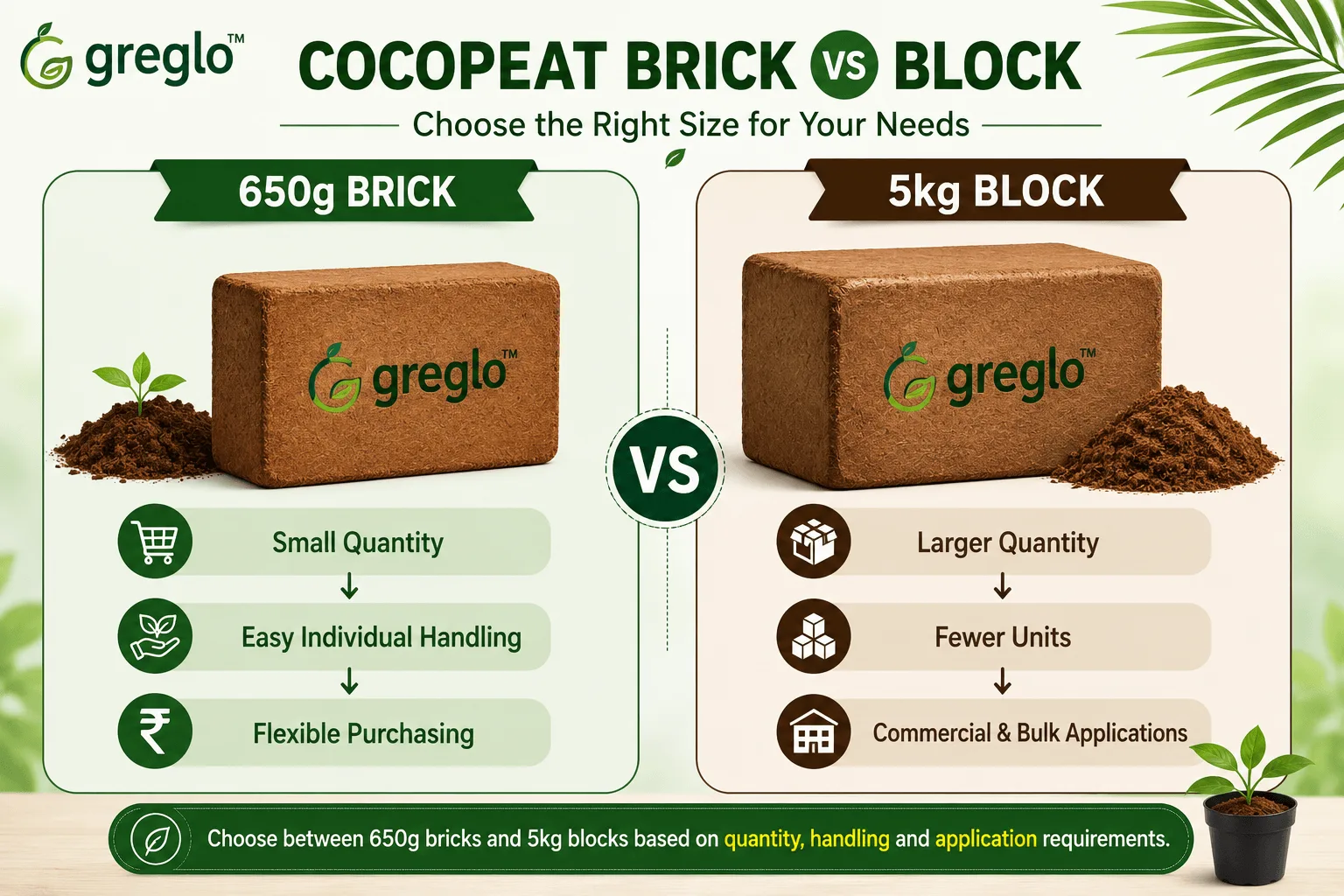
Both formats contain compressed coco peat, but they serve different purchasing and handling requirements.
|
Feature |
650g Cocopeat Brick |
5kg Cocopeat Block |
|
Format |
Smaller compressed unit |
Larger compressed block |
|
Handling |
Easy to handle individually |
Suitable for larger-volume handling |
|
Storage |
Requires more individual units for large quantities |
Fewer units for larger quantities |
|
Transportation |
Convenient for smaller shipments |
Efficient for larger quantities |
|
Suitable buyers |
Small and medium quantity users |
Commercial and bulk buyers |
|
Price comparison |
Usually evaluated per brick/kg |
Usually evaluated per block/kg |
|
Bulk purchasing |
Available depending on supplier |
Particularly practical for larger orders |
The right format depends on your quantity requirement, application, storage capacity, transportation requirements, and purchasing model.
What Factors Affect Coco Peat Cost?
Understanding the factors behind coco peat cost is important when comparing manufacturers and suppliers.
1. Product Format
Coco peat can be supplied in different compressed formats. The size and weight of the product influence packaging, handling, and transportation requirements.
2. Processing
Processing requirements can vary according to the desired product specifications. Washed, low-EC, or specially processed coco peat may require additional production steps.
3. EC Level
Buyers with specific crop or growing requirements may request a particular EC range. The processing required to achieve the specification can influence cost.
4. Expansion Capacity
Expansion capacity is an important consideration because the buyer ultimately needs usable growing medium after hydration.
A product that appears cheaper by weight may not necessarily provide the lowest effective cost if its expansion performance differs.
5. Moisture Content
Moisture affects the weight and transportation economics of coco peat. Buyers should compare products using clearly defined moisture specifications.
6. Particle Size
Different growing applications can require different particle structures. Fine, medium, or coarse material may have different processing requirements.
7. Packaging
Individual bricks, compressed blocks, bags, cartons, labels, and customized packaging can influence the final price.
8. Order Quantity
Wholesale and bulk orders generally have a different pricing structure from smaller purchases. Manufacturers may provide quotations based on the total quantity ordered.
9. Transportation
Freight can have a significant effect on the final delivered cost, particularly for large or distant shipments.
For this reason, buyers should compare delivered cost, not only the manufacturer's ex-factory or product price.
Coco Peat Wholesale Price: What Bulk Buyers Should Know
The coco peat wholesale price depends on the product specification, quantity, packaging, and delivery requirements.
Bulk buyers should provide manufacturers with clear requirements when requesting a quotation. Instead of asking only for the price of a block, provide details such as:
- Required product format
- Required weight
- Quantity
- EC requirement
- Moisture specification
- Particle size
- Packaging requirement
- Delivery location
- Expected delivery schedule
This allows the manufacturer to provide a more relevant quotation.
For example, a buyer looking for thousands of 5kg blocks should compare the complete order value, including packaging and transportation, rather than comparing only the unit price.
Infographic: Bulk Coco Peat Cost Calculation
① Product Price
Cost of the coco peat blocks, bricks, bags, or bulk quantity
↓ +
② Packaging Cost
Cost of packaging materials and export or bulk packing requirements
↓ +
③ Transportation Cost
Freight, local transport, shipping, and delivery expenses
↓ +
④ Other Applicable Costs
Handling, loading, taxes, documentation, or other applicable charges
⬇
Total Delivered Cost
Then Calculate
Total Delivered Cost ÷ Usable Expanded Volume
⬇
How to Compare Coco Peat Prices From Different Suppliers
When comparing quotations from manufacturers, use the same specifications for every supplier.
A simple comparison can include:
| Specification | Supplier A | Supplier B | Supplier C |
| Product format | |||
| Net weight | |||
| EC | |||
| pH | |||
| Moisture | |||
| Expansion volume | |||
| Packaging | |||
| MOQ | |||
| Freight | |||
| Delivered price |
This prevents buyers from selecting a supplier based only on the lowest headline price.
A manufacturer offering a slightly higher unit price may provide better expansion, lower moisture, suitable EC, stronger packaging, or more consistent specifications.
For commercial buyers, consistency is especially important because variations between batches can affect growing performance and operational planning.
Why Buy Coco Peat Directly From a Manufacturer?
Purchasing directly from a manufacturer can be useful for buyers who need consistent specifications or larger quantities.
A direct manufacturer relationship can make it easier to discuss:
- Product specifications
- Required quantities
- Packaging
- Quality requirements
- Bulk orders
- Delivery requirements
- Customized product requirements
For buyers purchasing cocopeat blocks or bricks regularly, working directly with a manufacturer can also simplify communication and repeat ordering.
If you are sourcing compressed coco peat products for commercial use, compare manufacturers based on product quality, production capability, specifications, consistency, and delivery requirements not only the quoted price.
How to Choose the Right Cocopeat Product
The right product depends on your quantity and application.
Choose 650g Cocopeat Bricks When:
- You need smaller compressed units
- Individual handling is important
- You want convenient storage
- Your purchase quantity is relatively smaller
- You prefer brick-format packaging
Choose 5kg Cocopeat Blocks When:
- You require larger quantities
- You are purchasing for commercial applications
- Fewer compressed units are preferred
- You need efficient bulk handling
- You are comparing wholesale quotations
Before purchasing either format, confirm the product specifications, expansion capacity, EC, moisture, packaging, MOQ, and delivery terms.
Conclusion
Understanding coco peat price in India requires more than comparing the price of individual bricks or blocks. Product format, weight, processing, EC, moisture, expansion capacity, packaging, order quantity, and transportation can all influence the final cost.
For buyers looking for compressed coco peat, 650g cocopeat bricks and 5kg cocopeat blocks provide practical formats for different purchasing requirements. Smaller bricks can be convenient for individual handling, while 5kg blocks can be suitable for larger-volume and commercial requirements.
Before placing an order, compare suppliers using the same specifications and calculate the total delivered cost and usable expanded volume. This helps you identify the product that provides the best overall value rather than simply choosing the lowest quoted price.
If you are looking for cocopeat 650g bricks or 5kg cocopeat blocks, review the product specifications and contact the manufacturer for current pricing, bulk quantities, packaging, and delivery requirements.
Frequently Asked Questions About Coco Peat Price
1. What is the coco peat price in India?
Coco peat pricing varies according to product format, weight, quality, processing, specifications, order quantity, packaging, and transportation. For accurate pricing, buyers should request a quotation based on their required product and quantity.
2. What is the price of a 650g cocopeat brick?
The price of a 650g cocopeat brick depends on product specifications, processing, packaging, order quantity, and delivery requirements. Buyers should compare the price together with expansion capacity and quality specifications.
3. How much does a 5kg cocopeat block cost?
The cost of a 5kg cocopeat block can vary depending on quality, EC, moisture, expansion capacity, packaging, MOQ, and delivery location. Bulk buyers should request a quotation based on their exact requirements.
4. Is coco peat cheaper when purchased in bulk?
Bulk purchasing can provide a different price structure from smaller orders, but the final cost also depends on packaging, specifications, freight, and delivery location. Buyers should compare the complete delivered cost.
5. How do I calculate coco peat price per kg?
Divide the total product price by the net product weight.
Price per kg = Total Product Price ÷ Net Weight
For a meaningful comparison, also check moisture, expansion capacity, and product specifications.
6. What should I check before buying cocopeat blocks?
Check the net weight, EC, pH, moisture, particle size, expansion capacity, packaging, MOQ, delivery terms, and supplier consistency before placing a bulk order.