
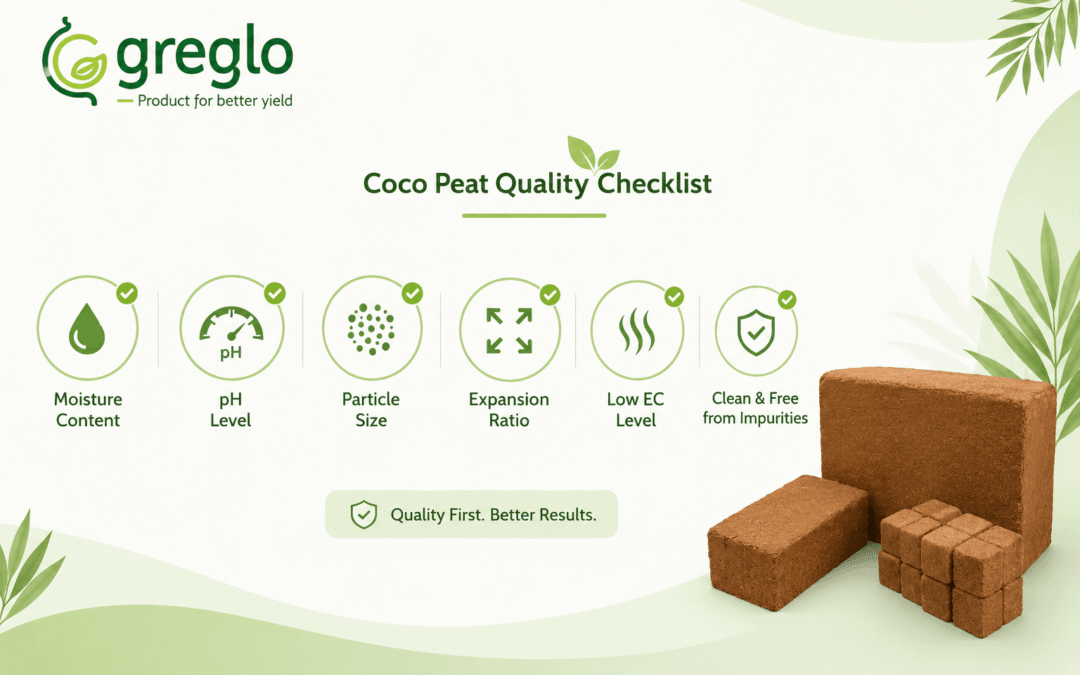
What to Check Before Buying Coco Peat Blocks & Bricks
Choosing coco peat based only on price can lead to inconsistent results. Different products can vary in EC, pH, moisture content, particle size, expansion capacity, compression, and cleanliness.
Whether you are purchasing 650g coco peat bricks for retail distribution or 5kg coco peat blocks for nurseries and commercial cultivation, checking the product specifications before buying can help you select the right growing medium.
This guide explains how to choose coco peat and the key quality factors buyers should evaluate before placing an order.
What Makes Good Quality Coco Peat?
Good-quality coco peat should be clean, consistently processed, and suitable for the intended growing application.
However, there is no single specification that is ideal for every buyer. The required characteristics can differ depending on whether the product is intended for seed germination, nursery plants, greenhouse cultivation, hydroponics, landscaping, or general horticulture.
Before purchasing, establish the required specifications and then compare products from different suppliers.
1. Check Coco Peat EC
EC, or electrical conductivity, is an important parameter when evaluating coco peat.
It provides an indication of the concentration of soluble salts in the material. Higher salt levels may not be suitable for certain sensitive crops or applications.
When comparing products, ask the supplier for the stated EC specification and understand how and under what testing conditions it was measured.
Do not compare EC figures blindly if the testing methods are different.
2. Check Coco Peat pH
pH is another important coco peat specification.
The pH of the growing medium can influence nutrient availability and the root-zone environment. Buyers should therefore check the supplier's stated pH range and confirm that it is appropriate for the intended crop or application.
For commercial orders, requesting a product specification sheet can make supplier comparison easier.
3. Check Moisture Content
Moisture content can affect the actual weight, storage stability, transportation, and handling of compressed coco peat.
When comparing two products with the same stated weight, differences in moisture can influence how much dry material the buyer is actually receiving.
Ask the supplier for the specified moisture range and check whether the quoted product weight is based on the supplied condition.
4. Compare Expansion Ratio
Expansion capacity is one of the most important factors when buying compressed coco peat.
A compact 650g brick or 5kg block occupies relatively little space during transportation, but it expands after water is added.
Buyers should ask:
- How much does the product expand?
- What volume is expected after hydration?
- How much water is recommended?
- Is the expansion figure based on laboratory testing or actual production batches?
Comparing usable expanded volume can provide a more meaningful assessment than comparing the price of compressed units alone.
5. Examine Particle Size
Particle size affects the physical characteristics of coco peat.
Different applications may require different grades. Fine particles can provide different water-retention characteristics from coarser material, while a balanced particle structure can influence both aeration and moisture availability.
Before ordering, confirm the particle-size specification and make sure it matches the intended application.
6. Evaluate Coco Peat Block Quality
For coco peat block quality, examine the consistency of the compressed block.
The block should be properly formed and stable enough for normal handling and transportation. At the same time, it should be capable of breaking down and expanding after hydration.
Look for:
- Uniform block shape
- Consistent weight
- Proper compression
- Clean material
- Minimal unwanted fibre or foreign matter
- Consistent expansion
For large commercial orders, requesting a sample before confirming the full quantity is a practical step.
7. Evaluate Coco Peat Brick Quality
The same principle applies to coco peat brick quality.
A 650g brick should have consistent dimensions and compression according to the agreed product specification.
Retail buyers and distributors should also consider packaging quality because damaged or poorly packed bricks can create problems during storage and transportation.
8. Check Packaging
Packaging protects compressed coco peat from moisture, contamination, and physical damage.
Ask the supplier about:
- Individual packaging
- Outer packaging
- Labeling
- Product weight
- Batch identification
- Storage requirements
- Export packaging, if applicable
The right packaging depends on whether the product is intended for domestic retail, wholesale distribution, commercial farming, or export.
9. Consider MOQ
MOQ, or minimum order quantity, is another important purchasing factor.
A supplier offering a low unit price may still not be suitable if the required MOQ is too high for your business.
Before placing an order, confirm:
- Minimum order quantity
- Available product formats
- Packaging quantity
- Production lead time
- Delivery location
- Payment terms
This helps you calculate the actual purchasing cost rather than focusing only on the advertised price.
10. Request Product Specifications
A reliable supplier should be able to explain the product specifications clearly.
For commercial purchases, request details such as:
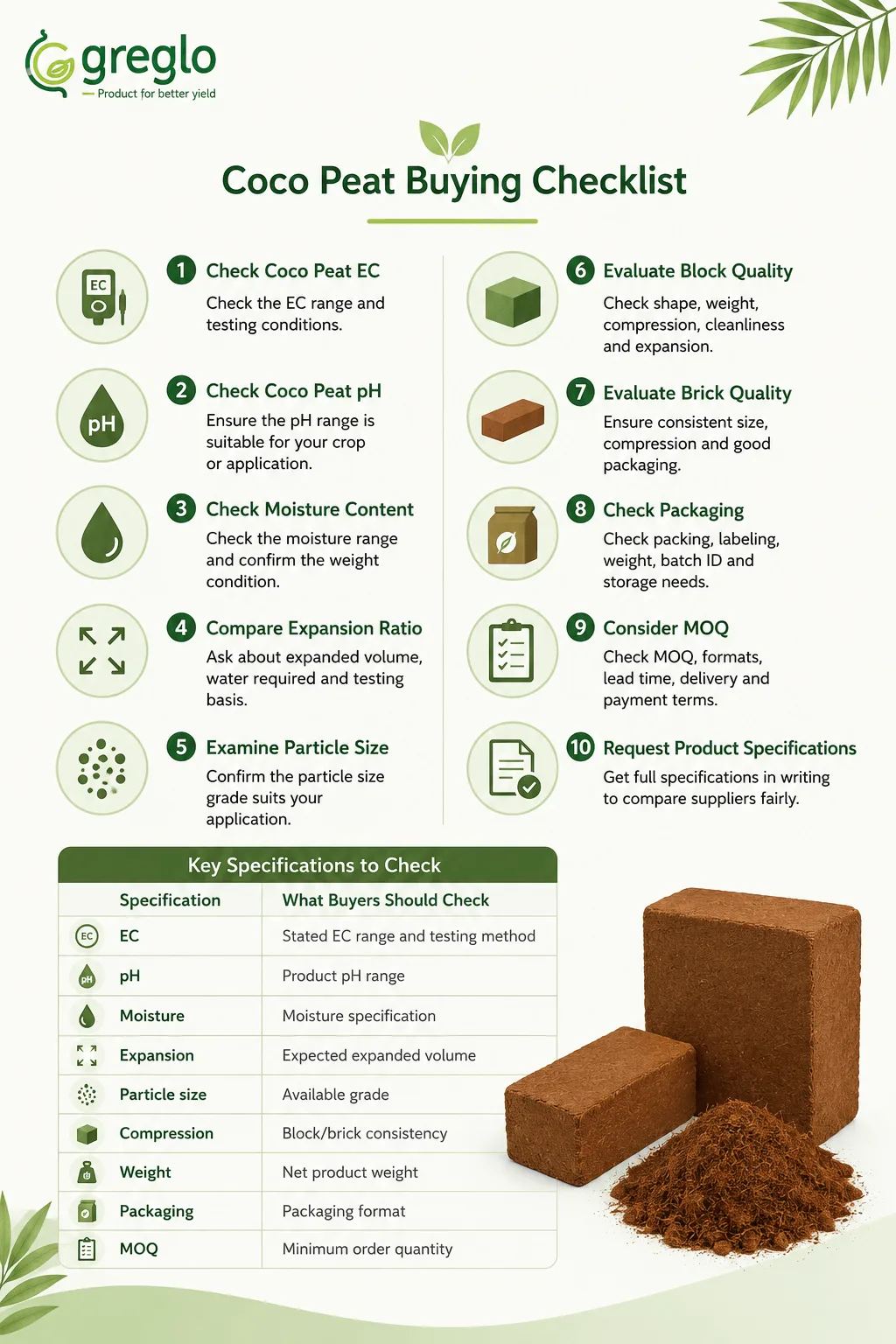
| Specification | What Buyers Should Check |
| EC | Stated EC range and testing method |
| pH | Product pH range |
| Moisture | Moisture specification |
| Expansion | Expected expanded volume |
| Particle size | Available grade |
| Compression | Block/brick consistency |
| Weight | Net product weight |
| Packaging | Packaging format |
| MOQ | Minimum order quantity |
Having these details in writing makes it easier to compare suppliers fairly.
Price vs Quality: What Should Buyers Compare?
The cheapest coco peat product is not always the most economical option.
For example, two 5kg blocks may have the same listed weight but different expansion capacities, moisture levels, particle characteristics, or quality specifications.
Instead of comparing only the coco peat price, consider the delivered cost and usable expanded volume.
A simple comparison is:
Delivered Cost ÷ Usable Expanded Volume = Cost per Usable Volume
This gives buyers a better understanding of the actual value of the product.
Sample Testing Before Bulk Purchase
For larger orders, requesting a sample is a useful quality-control step.
Test the sample according to your application requirements and compare it against the supplier's stated specifications.
Depending on your needs, you can evaluate:
- Expansion
- Moisture
- EC
- pH
- Particle size
- Cleanliness
- Packaging
- Physical compression
Once the sample meets your requirements, you can discuss the specifications for the bulk order.
650g Bricks vs 5kg Blocks: Which Should You Choose?
The right format depends on your purchasing and application requirements.
650g coco peat bricks are convenient for retail sales, smaller users, home gardening, nurseries, and applications where individual units are preferred.
5kg coco peat blocks are more suitable for commercial users who need larger quantities and want efficient storage and transportation.
The important point is to compare quality specifications in addition to weight and price.
Final Coco Peat Buying Checklist
Conclusion
Knowing how to choose coco peat can help buyers avoid comparing products based only on price.
EC, pH, moisture, expansion ratio, particle size, compression, packaging, and MOQ all contribute to the overall value of a coco peat product.
Whether you are sourcing 650g coco peat bricks or 5kg coco peat blocks, ask for clear specifications, evaluate a sample when appropriate, and compare the product based on its intended application.
If you are ready to source compressed coco peat products, explore our Cocopeat 650g Bricks and Cocopeat 5kg Blocks to find the format that fits your requirements.