
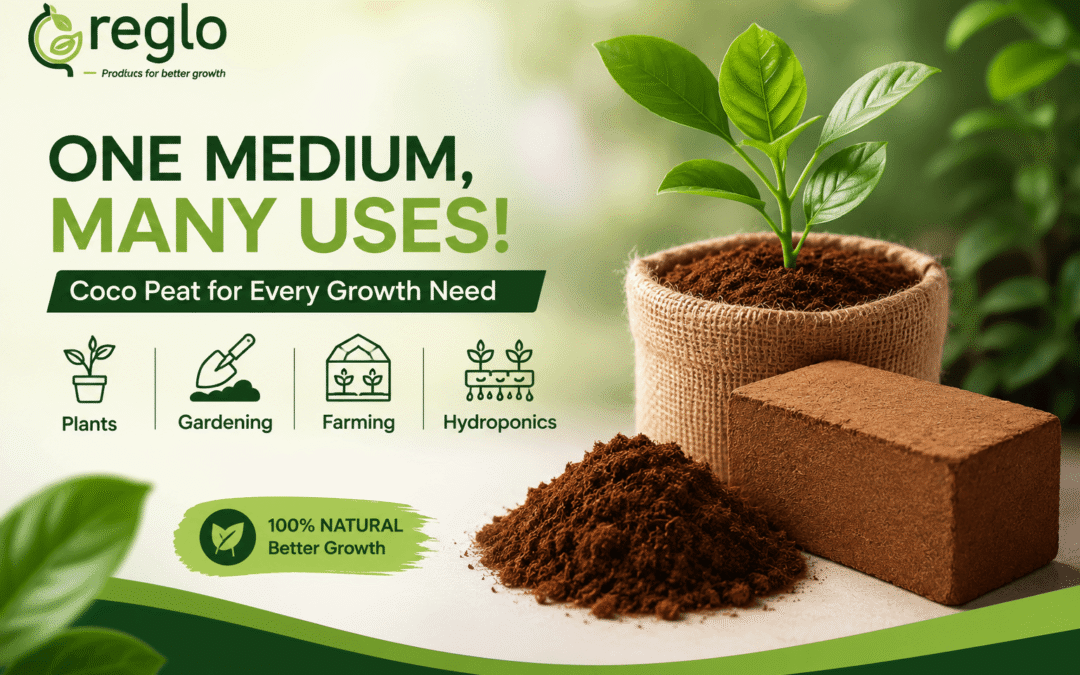
What Is Coco Peat Used For?
Coco peat uses range from seed germination and home gardening to nursery production, hydroponics, greenhouse cultivation, and commercial farming. Made from processed coconut husk, coco peat is a versatile growing medium that can help retain moisture while maintaining air space around plant roots.
The uses of coco peat can vary depending on the crop, growing method, particle size, grade, and product specifications. It can be used on its own for certain applications or combined with soil, compost, perlite, and other growing-media components to create a suitable root environment.
What Is Coco Peat?
Coco peat, also known as coir pith or coco coir pith, is obtained during the processing of coconut husks. After coir fibres are separated from the husk, the remaining pith is processed, screened, and prepared for horticultural applications.
Coco peat is commonly available in compressed formats such as 650g coco peat bricks and 5kg coco peat blocks. When water is added, the compressed material absorbs moisture and expands into a loose growing medium.
Because it is lightweight and can be compressed for storage and transportation, coco peat is used in a wide range of gardening, nursery, greenhouse, and commercial growing applications.
Why Is Coco Peat Used as a Growing Medium?
One of the main reasons coco peat is widely used is its ability to retain moisture while maintaining air spaces within the growing medium.
Depending on its grade and processing, coco peat can provide:
- Good moisture retention
- Useful aeration around plant roots
- Lightweight handling
- Convenient compressed storage
- Easier transportation
- Versatility in different growing systems
- Suitability for potting and soilless growing applications
These properties make coco peat a useful coco peat growing medium for different horticultural applications.
However, not all coco peat products have the same characteristics. Before buying, growers should consider factors such as EC, pH, particle size, moisture content, cleanliness, compression, and expansion capacity.
What Are the Main Coco Peat Uses?
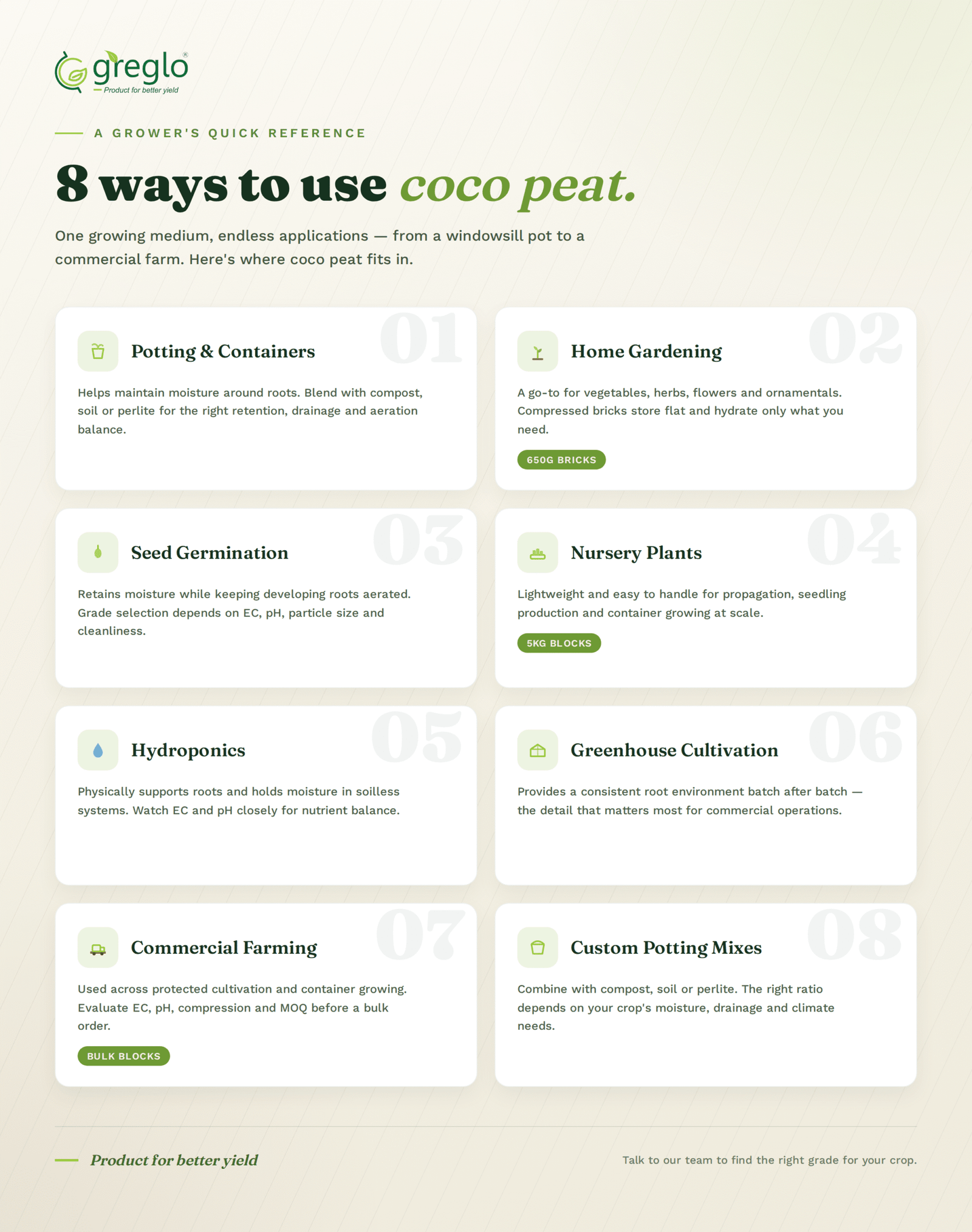
Coco peat has applications across home gardening, nurseries, hydroponics, greenhouse cultivation, and commercial farming. Some of the most common coco peat uses are explained below.
1. Coco Peat for Plants
One of the most common applications is coco peat for plants grown in pots and containers.
Coco peat for plants can be used as part of a potting medium to help maintain moisture around plant roots. Depending on the plant and cultivation method, it can be combined with compost, soil, perlite, or other suitable growing-media components.
For container gardening, the growing medium should provide a suitable balance between moisture retention, drainage, and root-zone aeration.
The appropriate coco peat mixture depends on the plant species, container size, watering practices, and other materials used in the growing medium.
2. Coco Peat for Gardening
Coco peat for gardening is commonly used by home gardeners growing vegetables, herbs, flowers, seedlings, and ornamental plants.
Compressed coco peat is particularly convenient because it requires relatively little storage space before hydration. Gardeners can hydrate only the quantity they need and prepare a growing medium according to their application.
For small-scale gardening, 650g coco peat bricks can be a convenient format because they are easy to handle, store, and prepare.
3. Coco Peat for Seed Germination
Coco peat for seed germination is widely used in seed-starting and propagation applications.
A suitable seed-starting medium needs to retain enough moisture while allowing sufficient air around developing roots. Fine or appropriately graded coco peat can be incorporated into seed-starting mixes for vegetables, flowers, herbs, and nursery plants.
When choosing coco peat for germination, it is important to consider:
- EC
- pH
- Particle size
- Cleanliness
- Moisture content
- Product consistency
The appropriate grade depends on the type of seed and the growing system.
4. Coco Peat for Nursery Plants
Coco peat for nursery plants can be used in propagation, seedling production, and container cultivation.
Nurseries can incorporate coco peat into growing mixes used for young plants. Its lightweight nature can also make handling, storage, and transportation more convenient.
For nurseries that use larger quantities of growing media, 5kg coco peat blocks can be a practical format for preparing larger batches of growing medium.
The product specification should be selected according to the nursery's crop, container size, irrigation system, and cultivation method.
5. Coco Peat for Hydroponics
Another important application is coco peat for hydroponics and other soilless growing systems.
Coco peat can provide physical support for plant roots while helping maintain moisture in the root zone. It can be used as a growing medium or as part of a growing-media blend, depending on the crop and hydroponic system.
Hydroponic growers should pay particular attention to EC and pH because nutrient and water management are important parts of soilless cultivation.
The physical characteristics of the coco peat, including particle size and water-holding properties, should also match the requirements of the growing system.
6. Coco Peat for Greenhouse Cultivation
Greenhouse cultivation requires a growing medium that can provide a consistent root environment.
Coco peat can be incorporated into greenhouse growing systems for vegetables, flowers, seedlings, and other crops. It may be used as part of a growing-media mix or in specific soilless cultivation systems.
For commercial greenhouse operations, consistency between batches is important. Buyers should evaluate product specifications rather than selecting a product based only on price.
7. Coco Peat for Commercial Farming
Coco peat for farming can be used in protected cultivation, nursery production, container growing, and various soilless cultivation systems.
Commercial growers may purchase coco peat in larger compressed blocks because they require significant quantities of growing media.
Before placing a bulk order, farmers should evaluate:
- Expansion volume
- EC
- pH
- Particle size
- Moisture content
- Compression
- Packaging
- Quantity requirements
- MOQ
- Delivery requirements
Testing a product sample before a large purchase can help growers confirm whether the material is suitable for their cultivation system.
8. Coco Peat in Potting Mixes
Coco peat can be combined with other materials to create a customized growing medium.
Depending on the crop and cultivation method, growers may combine coco peat with:
- Compost
- Soil
- Perlite
- Other suitable growing-media components
The appropriate coco peat soil mixture depends on the plant's moisture requirements, drainage needs, climate, irrigation practices, and the properties of the other components.
There is no single mixture that works for every plant. The growing medium should be adjusted according to the requirements of the crop and cultivation system.
Coco Peat Benefits
The popularity of coco peat comes from its useful physical properties and convenient compressed format.
Some important coco peat benefits include:
1. Moisture Retention
Coco peat can retain moisture within the growing medium, helping maintain moisture around plant roots.
2. Root-Zone Aeration
Its structure can provide air spaces within the growing medium, which can be useful for maintaining a suitable root environment.
3. Lightweight Growing Medium
Coco peat is relatively lightweight compared with many traditional growing-media materials, making it convenient for containers, nurseries, and handling.
4. Convenient Storage and Transportation
Compressed coco peat occupies less space before hydration. This can make storage and transportation more convenient for both small and large users.
5. Versatile Application
Coco peat can be used in gardening, seed starting, nurseries, greenhouses, hydroponics, and commercial growing systems.
The actual performance of coco peat depends on its grade, processing, specifications, and how it is incorporated into the growing system.
How to Use Coco Peat
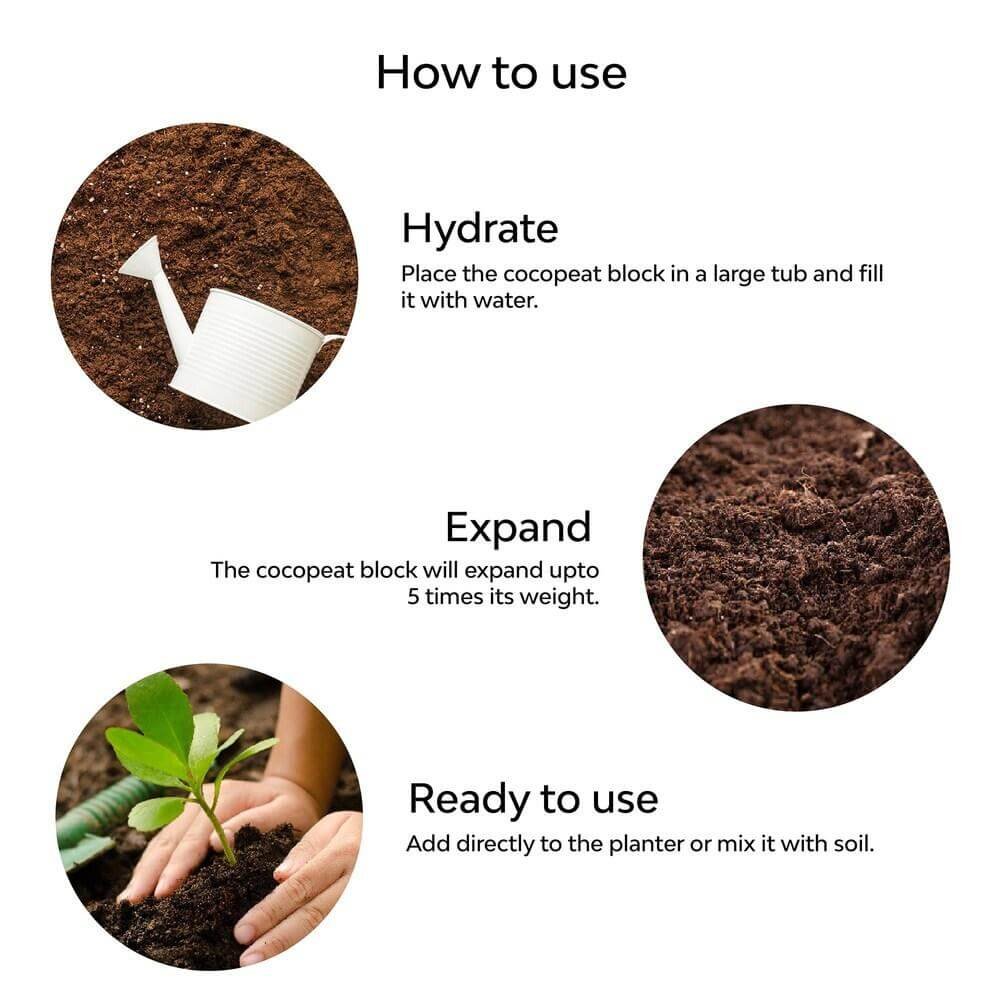
If you are wondering how to use coco peat, compressed coco peat needs to be hydrated before use.
A general preparation process is:
Step 1: Place the Compressed Brick or Block in a Suitable Container
Choose a container large enough to accommodate the expanded material.
Step 2: Add Water Gradually
Add water according to the product's recommended preparation instructions.
Step 3: Allow the Coco Peat to Absorb the Water
Give the compressed material sufficient time to absorb moisture and expand.
Step 4: Break Apart the Expanded Material
Once hydrated, loosen the coco peat thoroughly to create a uniform growing medium.
Step 5: Check the Material if Necessary
Remove unwanted particles or coarse material if your application requires a particular texture or particle size.
Step 6: Prepare the Growing Medium
Use the hydrated coco peat on its own where appropriate or combine it with other growing-media components according to the crop and cultivation system.
The amount of water required and final expansion can vary depending on the product's compression, moisture content, grade, and manufacturing specifications.
Therefore, it is better to follow the supplier's preparation instructions rather than assuming that every brick or block requires the same amount of water.
650g Coco Peat Bricks vs 5kg Coco Peat Blocks
Both 650g bricks and 5kg blocks are compressed coco peat formats, but they can suit different purchasing requirements.
| Product Format | Suitable For |
| 650g Coco Peat Brick | Home gardening, retail users, small nurseries, individual growers |
| 5kg Coco Peat Block | Nurseries, greenhouse cultivation, commercial growers, bulk users |
The best format depends on the amount of growing medium required, storage capacity, transportation requirements, and frequency of use.
Coco Peat vs Soil
- Coco peat and soil serve different purposes and should not always be treated as direct replacements.
- Soil is a natural growing medium containing mineral particles, organic matter, air, water, and other components. Coco peat is primarily used as a growing medium or as a component of a growing-media mix.
- Coco peat can be combined with soil and other materials to create a growing medium with the physical characteristics required for a particular crop.
Therefore, instead of asking whether coco peat is universally better than soil, growers should consider:
- Crop requirements
- Growing method
- Water management
- Nutrient program
- Drainage
- Root-zone conditions
- Climate and growing environment
For soilless cultivation systems, coco peat can provide a useful alternative or component of the growing medium, depending on the system and product specification.
Common Mistakes When Using Coco Peat
Avoid these common mistakes when preparing and using coco peat:
- Choosing a product without checking its specifications
- Ignoring EC and pH
- Selecting the wrong particle size
- Assuming every compressed brick or block has the same expansion
- Adding water without considering the product's preparation instructions
- Using the same growing-media mixture for every crop
- Ignoring the crop's drainage and moisture requirements
- Comparing products only by price
- Ordering large quantities without testing a sample
For commercial applications, it is often better to test a sample and confirm the product specifications before placing a large order.
Conclusion
The wide range of coco peat uses makes it a popular growing medium for gardening, seed germination, nursery plants, greenhouses, hydroponics, and commercial farming.
From small 650g coco peat bricks to larger 5kg coco peat blocks, compressed coco peat provides a convenient way to store, transport, and prepare growing media.
However, the right product should be selected according to its EC, pH, particle size, moisture, expansion capacity, compression, and intended application rather than price alone.
If you are looking for compressed coco peat for home gardening, nurseries, greenhouses, hydroponics, or commercial growing, explore our Cocopeat 650g Bricks and Cocopeat 5kg Blocks and compare their specifications according to your growing requirements.