
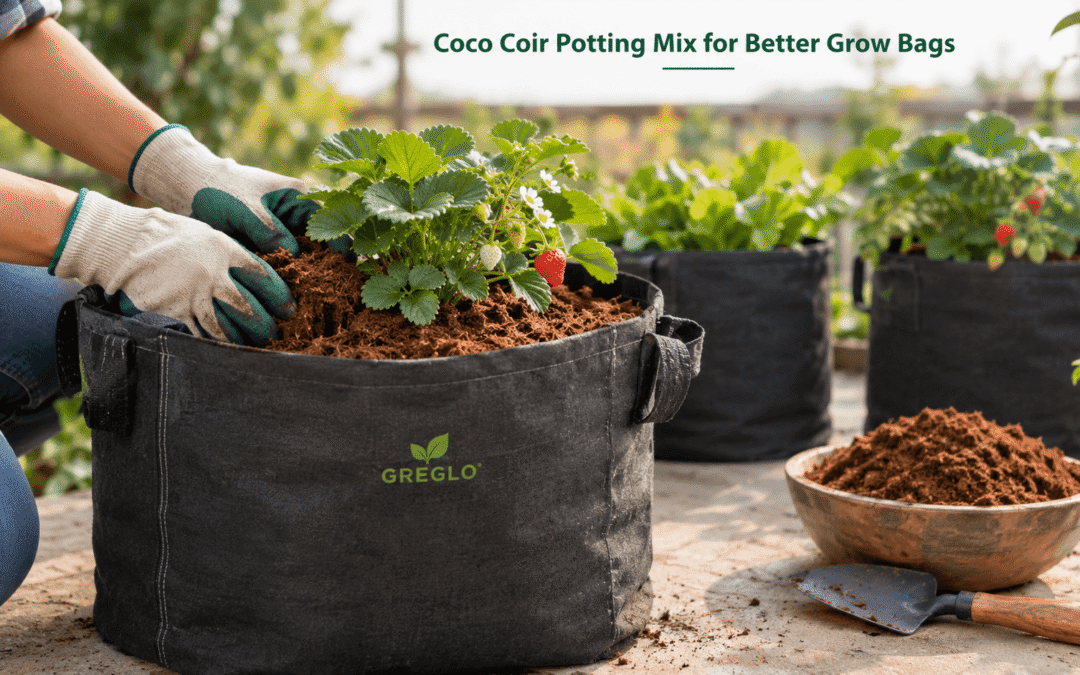
Choosing the right growing medium is an important part of successful container gardening. Coco coir potting mix is widely used as a component of growing media for vegetables, herbs, flowers, seedlings, and other plants grown in containers.
When used with grow bags for plants, coco coir can help create a lightweight growing environment with useful moisture-management and aeration characteristics. However, coco coir alone may not provide everything a plant needs, so the final growing-medium formulation should be selected according to the crop and growing conditions.
This guide explains what coco coir potting mix is, how to use it in grow bags, what to combine with it, and what specifications to check when buying coco coir.
🌱 What Is Coco Coir Potting Mix?
Coco coir potting mix is a growing-medium formulation that uses processed coconut coir as one of its components.
Coco coir comes from coconut husks and can be processed into different forms and particle sizes.
Depending on the product and application, coco coir may be available as:
🧱 Cocopeat blocks
🧱 Cocopeat bricks
🥥 Coir pith
🌿 Coir-based growing media
🪵 Coir chips or other coir components
Its physical properties can make it useful for container and controlled growing applications.
💧 Why Use Coco Coir in Grow Bags?
When used appropriately, coco coir can contribute to the physical structure of a growing medium.
1. Moisture Management
Coco coir can retain moisture while still allowing air spaces within the growing medium.
2. Root Aeration
Its structure can help maintain air space around plant roots when the medium is properly formulated.
3. Lightweight Structure
Coco coir is generally lighter than many traditional mineral-based growing materials, making it practical for container applications.
4. Renewable Raw Material
Coco coir is derived from coconut husks, a by-product of coconut processing.
5. Suitable for Container Growing
It can be incorporated into growing media used in pots and grow bags for plants.
A simple concept is:
🥥 Coco Coir → 💧 Moisture Retention → 🌬️ Air Space → 🌱 Root Environment
What Should Be Added to Coco Coir Potting Mix?
When used appropriately, coco coir can contribute to the physical structure of a growing medium.
1. Moisture Management
Coco coir can retain moisture while still allowing air spaces within the growing medium.
2. Root Aeration
Its structure can help maintain air space around plant roots when the medium is properly formulated.
3. Lightweight Structure
Coco coir is generally lighter than many traditional mineral-based growing materials, making it practical for container applications.
4. Renewable Raw Material
Coco coir is derived from coconut husks, a by-product of coconut processing.
5. Suitable for Container Growing
It can be incorporated into growing media used in pots and grow bags for plants.
A simple concept is:
🥥 Coco Coir → 💧 Moisture Retention → 🌬️ Air Space → 🌱 Root Environment
What Should Be Added to Coco Coir Potting Mix?
Coco coir can be used as one component of a growing medium rather than automatically treating it as a complete potting mix.
Depending on the crop, you may combine it with materials such as:
🌱 Compost
🪱 Vermicompost
🌬️ Perlite or another aeration component
🪨 Other suitable growing-medium materials
🧪 Crop-specific nutrient inputs
A general formulation concept is:
🥥 Coco Coir + 🌱 Organic Matter + 🌬️ Aeration Component + 🧪 Nutrient Management → 🌿 Growing Medium
The exact ratio should not be treated as universal. Plant species, climate, watering frequency, container size, and growing method all influence the appropriate formulation.
🪴 Coco Coir Potting Mix for Grow Bags
Coco coir potting mix can be particularly useful in grow-bag systems where the growing medium needs to balance moisture retention, drainage, and root-zone air space.
A practical setup is:
👜 Grow Bag → 🥥 Coco Coir Mix → 🌱 Plant → 💧 Controlled Watering → 🌿 Root Development
The grow bag itself should have an appropriate size and drainage design.
The growing medium should also be loose enough to provide suitable root-zone conditions without becoming excessively compacted.
For more information about selecting the container, see [Potting Bags for Plants: Sizes, Types & Buying Guide] → /blog/potting-bags-for-plants/
🧪 What to Check When Buying Coco Coir
Coco coir potting mix can be particularly useful in grow-bag systems where the growing medium needs to balance moisture retention, drainage, and root-zone air space.
A practical setup is:
👜 Grow Bag → 🥥 Coco Coir Mix → 🌱 Plant → 💧 Controlled Watering → 🌿 Root Development
The grow bag itself should have an appropriate size and drainage design.
The growing medium should also be loose enough to provide suitable root-zone conditions without becoming excessively compacted.
For more information about selecting the container, see [Potting Bags for Plants: Sizes, Types & Buying Guide] → /blog/potting-bags-for-plants/
How to Prepare Coco Coir for Grow Bags
If you are using compressed cocopeat blocks or bricks, follow the manufacturer's preparation instructions.
A general process is:
🧱 Compressed Cocopeat → 💧 Add Water → ⏳ Hydrate → 🔄 Break Apart → 🌿 Check Texture → 👜 Fill Grow Bag
1. Hydrate the Coco Coir
Add the recommended amount of water and allow the compressed material to expand.
2. Break Apart the Material
Once hydrated, loosen the coco coir to create an even texture.
3. Check the Moisture
The material should be adequately hydrated without being unnecessarily saturated.
4. Prepare the Final Mix
Combine the coco coir with other components if required for your crop.
5. Fill the Grow Bag
Place the prepared growing medium into the appropriate grow bags for plants.
6. Plant and Manage
Plant according to crop requirements and manage watering and nutrients based on the growing environment.
🌱 Which Plants Can Use Coco Coir Potting Mix?
A suitable coco-coir-based growing medium can be used for many container-grown plants.
🍅 Vegetables
Tomatoes, chillies, peppers, leafy vegetables, and other crops can be grown in coco-coir-based media when the formulation is appropriate.
🌿 Herbs
Many herbs can be grown in containers using coco coir as part of the growing medium.
🌸 Flowers
Coco-coir-based media can also be used for many flowering plants.
🌱 Seedlings
Coco coir is commonly incorporated into growing media for seed starting and nursery production.
The final formulation should always be adapted to the crop rather than using one mix for every plant.
🌱 Which Plants Can Use Coco Coir Potting Mix?
A suitable coco-coir-based growing medium can be used for many container-grown plants.
🍅 Vegetables
Tomatoes, chillies, peppers, leafy vegetables, and other crops can be grown in coco-coir-based media when the formulation is appropriate.
🌿 Herbs
Many herbs can be grown in containers using coco coir as part of the growing medium.
🌸 Flowers
Coco-coir-based media can also be used for many flowering plants.
🌱 Seedlings
Coco coir is commonly incorporated into growing media for seed starting and nursery production.
The final formulation should always be adapted to the crop rather than using one mix for every plant.
💦 How to Water Coco Coir in Grow Bags
Coco coir can retain moisture, but watering requirements still vary according to the plant and growing conditions.
Consider:
🌡️ Temperature
☀️ Sunlight
💨 Wind
🌱 Plant size
👜 Grow bag size
🥥 Growing-medium composition
💧 Drainage
🌦️ Weather
A useful management cycle is:
🌱 Check Moisture → 💧 Water as Required → ⬇️ Allow Drainage → 👀 Monitor Plant Response
Avoid following a fixed watering schedule without considering actual growing conditions.
Common Mistakes When Using Coco Coir
- Overwatering
Coco coir can retain moisture, so watering should be adjusted according to the plant and environmental conditions.
- Ignoring EC
Check the EC specification of the coco coir, especially when using it for sensitive crops or controlled growing systems.
- Treating Coco Coir as Complete Nutrition
Coco coir primarily serves as a growing-medium component. Plants still require an appropriate nutrient program.
- Ignoring Expansion Volume
When buying compressed blocks, compare the usable expanded volume rather than looking only at the dry block weight.
- Using Inconsistent Products
For repeated growing cycles, inconsistent particle size, EC, moisture, or expansion can make growing-medium management more difficult.
- Ignoring Drainage
Even a suitable coco coir medium requires an appropriate container and drainage system.
Coco Coir vs Traditional Potting Mix
|
Feature |
Coco Coir-Based Mix |
Traditional Potting Mix |
|
Moisture management |
Generally good |
Depends on formulation |
|
Weight |
Generally lightweight |
Varies |
|
Structure |
Depends on particle size and formulation |
Depends on ingredients |
|
Nutrients |
Requires nutrient management |
Depends on formulation |
|
Container use |
Suitable |
Suitable |
|
Customization |
Can be blended with other materials |
Depends on the product |
GREGLO Cocopeat Growing Media
GREGLO provides cocopeat and coco coir growing-media solutions for different growing applications.
For grow bags for plants, selecting the right combination of container and growing medium is important. The required specifications can vary depending on the crop, growing method, irrigation system, and growing environment.
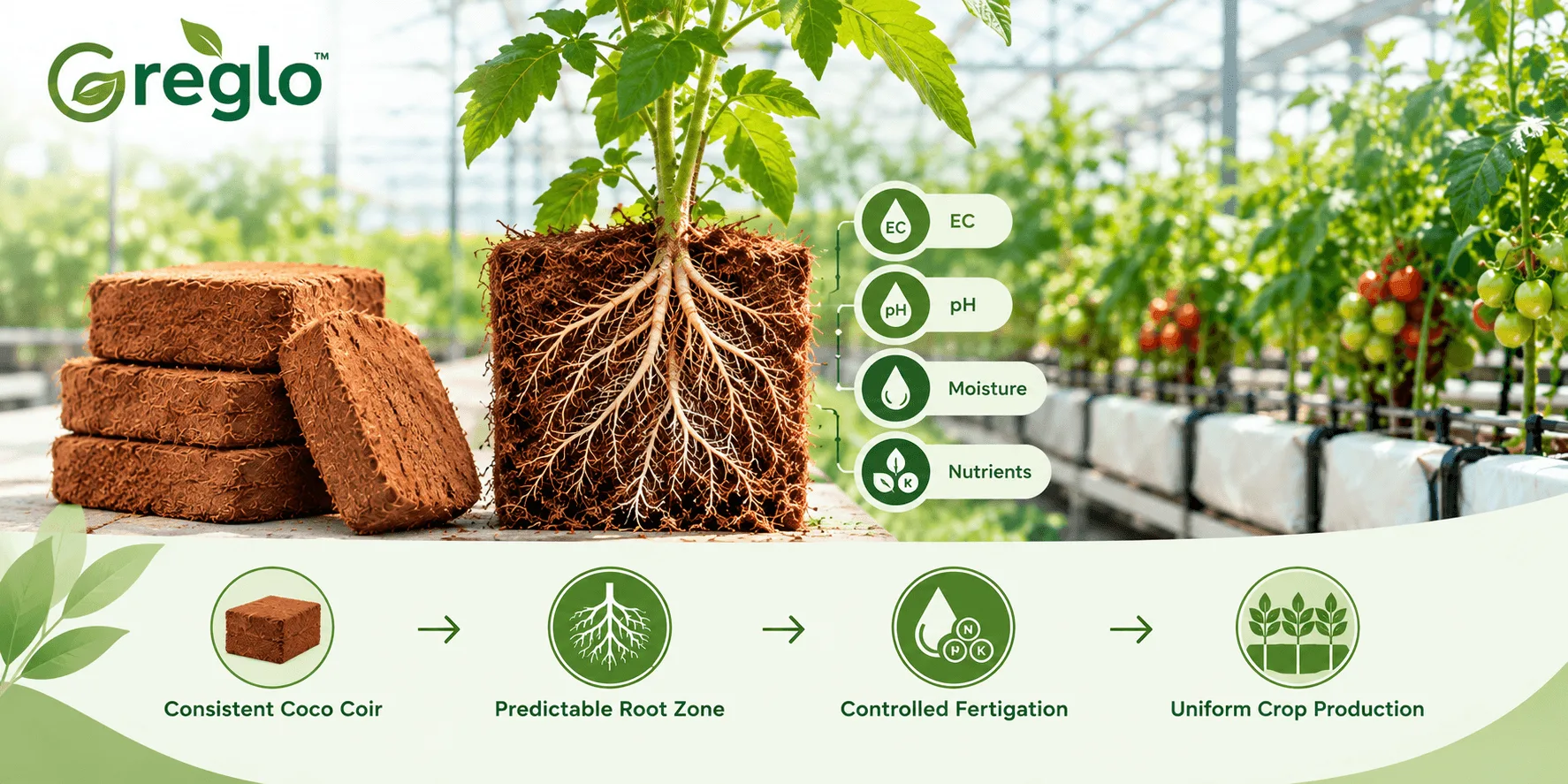
GREGLO's cocopeat formats can be evaluated based on factors such as EC, pH, moisture, particle size, expansion volume, and application requirements.