

🫐 What Soil pH Do Blueberries Need?
Blueberries are acid-loving plants that require a more acidic root environment than many common fruit and vegetable crops. Getting the blueberry soil pH right is one of the most important steps when establishing healthy blueberry plants.
In general, blueberries perform well when the root-zone pH is maintained around 4.5 to 5.5. The exact target can vary with cultivar, growing system and local conditions, so growers should use testing rather than relying on assumptions.
For growers in India, managing pH becomes particularly important when blueberries are grown in containers, grow bags or controlled growing media.
What Soil pH Do Blueberries Need?
The preferred pH for blueberry plants is generally acidic, with a commonly recommended range of approximately 4.5–5.5.
Soil or growing media outside this range can affect nutrient availability and root function. A growing medium may contain adequate nutrients, but if the pH is unsuitable, some nutrients may become less available to the plant.
Maintaining the appropriate blueberry plant soil pH can support:
-
- Better nutrient availability
- Healthy root development
- Efficient nutrient uptake
- Strong vegetative growth
- Good growing conditions for fruit production
The objective is not to make the soil as acidic as possible. Blueberries need a stable and suitable acidic root environment, not extremely low pH.
🌱 Why Does pH Matter for Blueberries?
Soil pH influences the chemical availability of nutrients around the plant's roots.
When the root-zone pH becomes too high, certain nutrients—particularly iron—can become less available. This can contribute to symptoms such as yellowing young leaves and reduced growth.
However, leaf yellowing can have several causes. Nutritional deficiencies, root problems, irrigation issues and other growing conditions can produce similar symptoms.
That is why testing the growing medium is more reliable than diagnosing a pH problem from leaf appearance alone.
🌱 Why Is Acidic Soil Important for Blueberries?
Blueberries naturally prefer acidic soil for blueberries because their roots are adapted to low-pH conditions.
One important benefit of maintaining an acidic root zone is improved nutrient availability. When the pH rises too far above the preferred range, certain nutrients may become less accessible to the plant.
Possible signs of an unsuitable root-zone environment include:
-
- Yellowing younger leaves
- Reduced plant growth
- Weak foliage
- Poor plant vigor
Reduced overall performanceThese symptoms are not specific to pH, however. A proper diagnosis should consider soil or growing-medium testing, irrigation water, nutrition and root health.
💧 Don't Make the Soil Too Acidic
A common mistake is assuming that a lower pH is always better for blueberries.
It isn't.
Blueberries require an appropriate acidic range, rather than extremely acidic conditions. Excessive acidity can also interfere with nutrient availability and may negatively affect root health.
The best approach is simple:
Test first. Adjust carefully. Monitor regularly.
How to Check Blueberry Soil pH
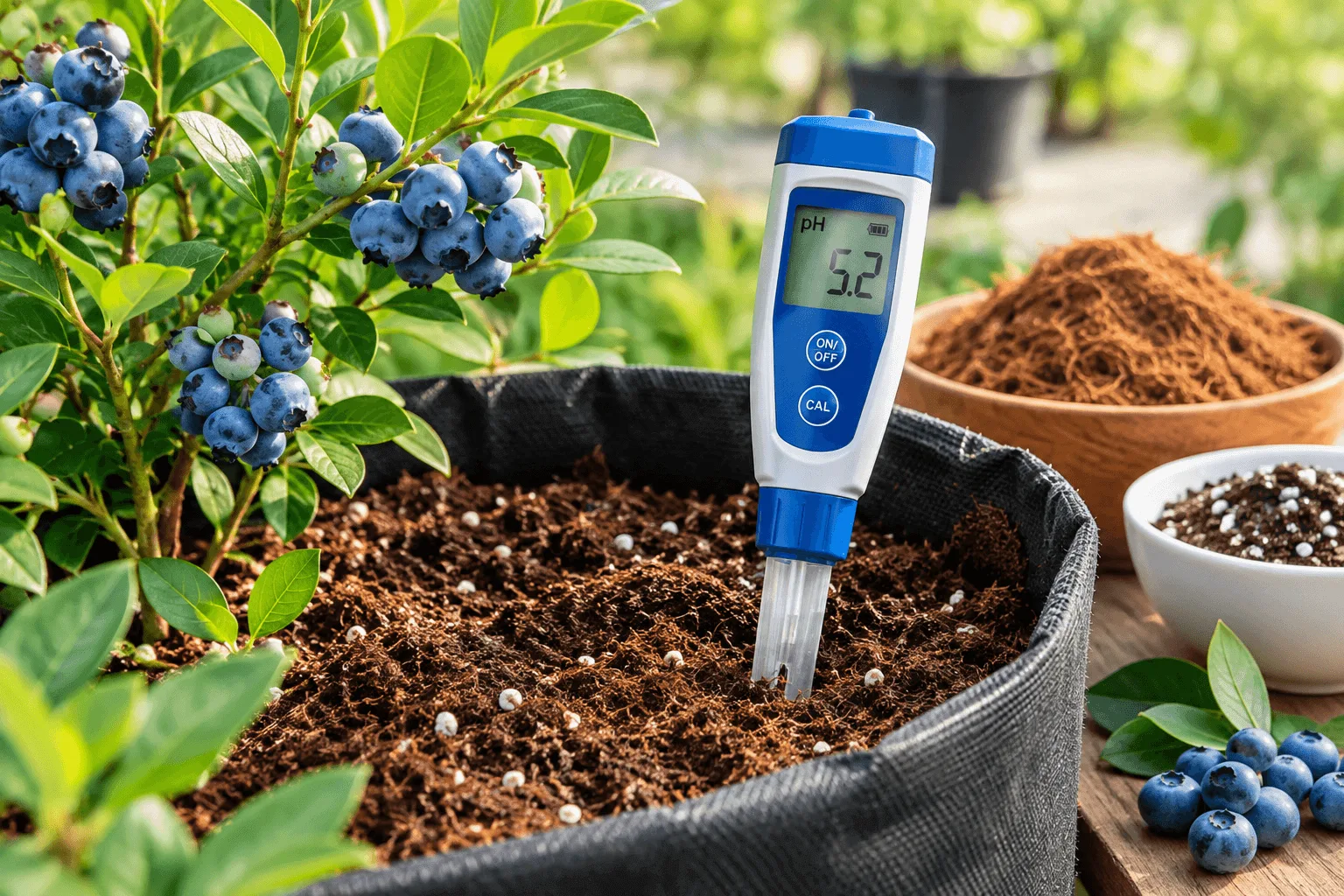
Testing gives growers a starting point and helps determine whether the growing medium is appropriate for blueberries.
🧪 1. Test Before Planting
Before planting blueberry plants in India, test the soil or growing medium you plan to use.
This helps establish the starting pH and identifies whether adjustments may be necessary before planting.
🧪 2. Use a Reliable pH Test
A suitable soil pH meter or testing kit can provide a useful indication of pH.
For commercial production or situations where accuracy is particularly important, laboratory testing can provide more detailed information about the growing medium.
🧪 3. Test the Finished Growing Medium
If blueberries are grown in containers or grow bags, test the complete medium that will surround the roots.
Don't rely solely on the pH of one ingredient.
For example, if coco coir is combined with other materials, the final mixture should be evaluated rather than assuming that the individual ingredients will automatically produce the correct pH.
🧪 4. Monitor pH Over Time
Blueberry soil pH can change over time due to:
-
- Irrigation water
- Fertilizers
- Acidifying amendments
- Growing-medium decomposition
- Other chemical changes in the root zone
Regular monitoring can help identify gradual pH changes before they become a major growing problem.
🇮🇳 Blueberry Soil pH for Growing Blueberries in India
Blueberry cultivation in India requires careful attention to the root environment as well as climate and cultivar requirements.
Native soils are not always naturally suitable for blueberries. In locations where soil pH is significantly higher than the preferred acidic range, correcting a large area of native soil can be difficult and expensive.
This is one reason controlled growing systems can be useful for blueberry plants in India.
1. 🪴 Controlled Growing Media
Growing blueberries in containers or grow bags allows growers to manage several aspects of the root environment, including:
-
- Growing-medium composition
- Blueberry soil pH
- Drainage
- Moisture retention
- Root-zone aeration
- Fertilizer management
Rather than modifying a large area of native soil, growers can create a more controlled root-zone environment.
This can be particularly useful for growers experimenting with blueberries in regions where naturally acidic soil is not available.
2. 🌡️ pH Isn't the Only Factor
A suitable pH is important, but it does not guarantee successful blueberry farming in India.
Growers should also consider:
-
- Cultivar selection
- Temperature
- Chill requirements
- Sunlight
- Irrigation
- Drainage
- Growing-medium structure
- Nutrition
A well-managed pH cannot compensate for unsuitable temperature, inadequate drainage or an inappropriate cultivar.
Can Coco Coir Be Used for Blueberries?
Yes. Coco coir can be used as a component of a blueberry growing medium, particularly in container and grow-bag systems.
Coco coir can provide useful physical properties for root-zone management, including moisture retention and air space. However, coco coir should not automatically be treated as a complete blueberry growing medium.
The important question is not simply whether coco coir is suitable.
The important question is whether the finished growing medium provides the right chemical and physical environment for blueberry roots.
🌱 What Should You Check?
When using coco coir, growers should consider:
-
- pH
- EC
- Moisture retention
- Drainage
- Air-filled porosity
- Particle structure
- Nutrient management
Most importantly, don't assume that adding coco coir alone will automatically create the correct pH soil for blueberries.
For growers using Greglo cocopeat, this provides an opportunity to develop a controlled growing medium around the specific requirements of blueberry plants rather than relying on a single material as the complete solution.
💧 Don't Ignore Irrigation Water
Irrigation water is an important part of long-term pH management.
Water with high alkalinity can gradually influence the growing medium and push the root-zone pH upward over time.
This means that a growing medium may initially have an appropriate blueberry soil pH, but its pH can change as the plants are repeatedly irrigated.
For this reason, growers should consider testing irrigation water as well as the growing medium, particularly in commercial production systems.
Monitoring both can provide a better understanding of why pH changes over time.
Common Blueberry Soil pH Mistakes
❌ Not Testing the Soil
Never assume that garden soil has the correct pH for blueberries.
Test before planting.
❌ Ignoring Irrigation Water
Irrigation water can influence the root-zone environment over time, particularly when alkalinity is high.
❌ Adding Too Much Acidifying Material
More acidity does not necessarily mean healthier blueberries.
Excessive amendments can push the pH below the desired range and create additional nutrient problems.
❌ Focusing Only on pH
A suitable pH does not guarantee healthy plants.
Drainage, moisture, aeration, nutrition, temperature and cultivar requirements also matter.
❌ Testing Only One Ingredient
Testing the pH of coco coir, soil or another individual component does not necessarily tell you the pH of the final blueberry growing medium.
Always evaluate the finished root-zone medium.
Conclusion
Getting the blueberry soil pH right is an important starting point for healthy blueberry growth.
Blueberries generally prefer an acidic root environment, commonly around pH 4.5–5.5, although the appropriate target can vary with cultivar and production system.
For blueberry cultivation in India, controlled growing media can make it easier to manage pH, moisture, drainage and root-zone conditions.
Coco coir can be incorporated into a blueberry growing medium, but the final mixture should be evaluated rather than assuming that one ingredient will automatically provide ideal conditions.
The most practical approach is straightforward:
Test first, adjust carefully, and monitor regularly.
This helps create a more stable root environment for healthy blueberry plants in India.