
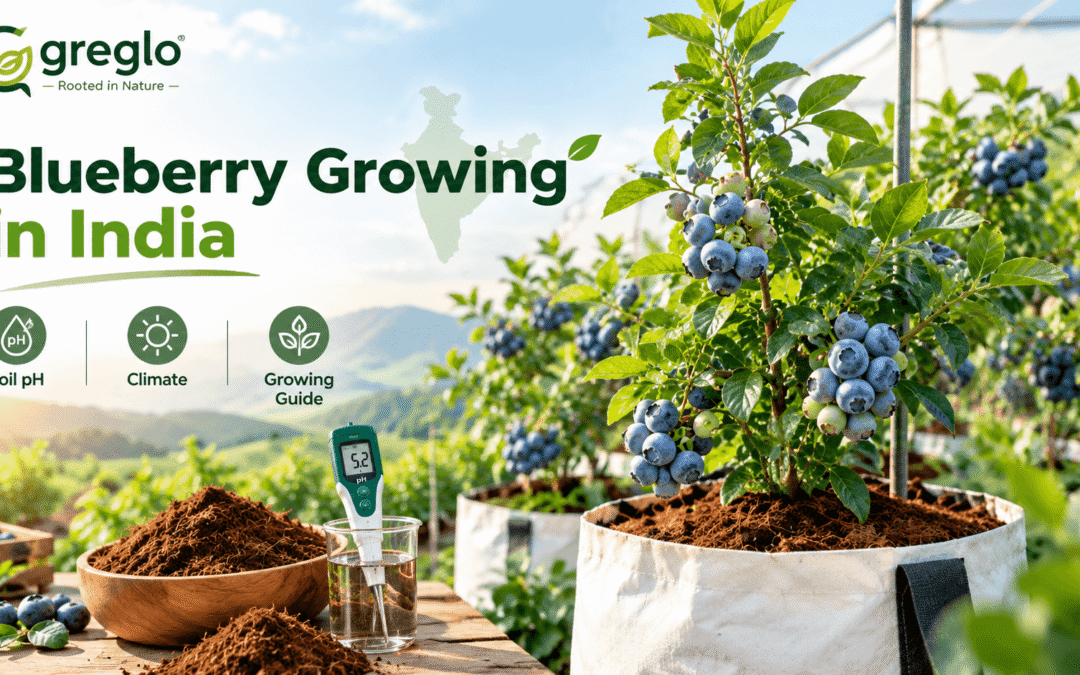
Blueberry cultivation in India is attracting interest among growers looking for high-value fruit crops and controlled cultivation systems. However, blueberries have specific requirements that are different from many commonly grown fruits.
One of the most important factors is the root-zone environment. Blueberries prefer acidic conditions, so understanding blueberry soil pH, growing-medium structure, irrigation, temperature, and cultivar selection is essential before planting.
For growers working with unsuitable native soil, containers and grow bags can provide greater control over the growing environment.
Can Blueberries Be Grown in India?
Yes, blueberries can be grown in parts of India when the cultivar and growing conditions are appropriately matched.
However, successful blueberry farming in India depends on several factors rather than soil pH alone.
Important considerations include:
-
-
- Suitable blueberry cultivar
- Temperature
- Chill requirement
- Soil or growing-medium pH
- Drainage
- Irrigation
- Sunlight
- Root-zone aeration
- Growing system
-
Different blueberry cultivars have different environmental requirements, so growers should select varieties according to their local conditions.
Climate Requirements for Blueberry Cultivation
Climate is an important consideration when planning blueberry cultivation in India.
Blueberries are not suited to every climate or growing location. Depending on the cultivar, plants may have specific chilling requirements and temperature preferences.
Before establishing a plantation, growers should evaluate:
☀️ Temperature
Consider both seasonal temperatures and extreme heat.
High temperatures can place additional stress on blueberry plants, particularly when moisture management is poor.
❄️ Chill Requirement
Some blueberry cultivars require a specific amount of winter chilling to perform properly.
Low-chill cultivars may be more appropriate for warmer regions, depending on the production system.
💧 Water Availability
Consistent irrigation is important, particularly during active growth and fruit development.
Water quality should also be considered because irrigation water can influence the root-zone environment over time.
What Soil Do Blueberries Need in India?
The natural soil in a particular location may not always provide the conditions required by blueberries.
The most important characteristic to check is blueberry soil pH.
Blueberries generally prefer an acidic root-zone environment, commonly around pH 4.5–5.5, although the preferred range can vary by cultivar and production system.
A suitable growing medium should also provide:
-
-
- Good drainage
- Adequate moisture retention
- Root-zone aeration
- Suitable physical structure
- Consistent nutrient availability
-
Simply lowering the soil pH isn't enough if the soil remains compacted or poorly drained.
Why Blueberry Soil pH Matters
Blueberries have adapted to acidic growing conditions.
When the pH becomes too high, the availability of certain nutrients can be affected. This may result in symptoms such as yellowing leaves or weak plant growth.
This is why blueberry plant soil pH should be tested before planting.
🧪 Test Before You Plant
A soil or growing-medium test can tell you whether your starting conditions are appropriate.
If you're growing blueberries in containers, test the complete growing medium rather than relying on the pH of a single component.
⚠️ Don't Overcorrect the pH
A lower pH isn't automatically better.
Make adjustments according to the test result and the requirements of the selected cultivar.
For a detailed guide, see our main article on blueberry soil pH in India.
Can Coco Coir Be Used for Blueberry Cultivation?
Coco coir can be incorporated into a controlled growing medium for blueberries.
This can be particularly relevant when growers use containers, grow bags, nurseries, or other systems where the root environment can be prepared independently of native soil.
1. Coco coir can contribute to:
-
-
- Moisture management
- Root-zone structure
- Air space
- Consistent growing-medium characteristics
-
However, coco coir for blueberries should not automatically be treated as a complete growing medium.
2. Growers should consider the finished mix's:
-
-
- pH
- EC
- Moisture retention
- Drainage
- Air-filled porosity
- Particle structure
-
Testing the complete growing medium is more useful than assuming that one ingredient will provide the correct conditions.
Growing Blueberries in Containers and Grow Bags
For some growers, containers and grow bags can provide greater control over the root environment.
This can be useful when native soil has an unsuitable pH or poor drainage.
🌱 Advantages of a Controlled Growing Medium
A container-based system can make it easier to manage:
-
-
- Blueberry soil pH
- Moisture
- Drainage
- Root-zone aeration
- Growing-medium composition
-
Growers can prepare a purpose-built medium rather than trying to modify a large area of native soil.
💧 Drainage Is Essential
Blueberries need consistent moisture, but excessive water around the roots can create unfavorable conditions.
Use containers or grow bags with appropriate drainage and a growing medium that allows excess water to escape.
For more information, see our guide to growing blueberries in grow bags.
Irrigation and Water Quality
Irrigation should provide consistent moisture without keeping the root zone saturated.
How frequently blueberries need water depends on factors such as:
-
-
- Temperature
- Humidity
- Container size
- Plant size
- Growing-medium structure
- Sun exposure
- Growth stage
-
Water quality also deserves attention.
If irrigation water has high pH or alkalinity, it can influence the growing-medium environment over time.
For controlled blueberry production, monitoring both the growing medium and irrigation water can help maintain more consistent root-zone conditions.
Nutrient Management
Blueberries have specific nutritional requirements, and nutrient availability is closely connected with the root-zone environment.
A suitable pH soil for blueberries helps create conditions where nutrients can be accessed effectively.
However, fertilizer should not be used as a substitute for correcting fundamental growing-medium problems.
Before adjusting nutrition, consider:
-
-
- Soil or growing-medium pH
- EC
- Irrigation-water quality
- Plant growth
- Leaf appearance
- Growing-medium moisture
-
A measured approach is preferable to applying large quantities of fertilizer based only on visible symptoms.
Common Mistakes in Blueberry Farming in India
Choosing a Cultivar Without Considering Climate
Not every blueberry variety is suitable for every Indian growing region.
Check the cultivar's chill and temperature requirements before planting.
Using High-pH Native Soil Without Testing
Don't assume that local soil is naturally suitable for blueberries.
Test it first.
Ignoring Drainage
Even the correct blueberry soil pH cannot compensate for poor drainage.
Overwatering
Keeping the root zone continuously saturated can create additional problems.
Ignoring Irrigation Water
Water chemistry can gradually influence the growing environment.
Making Large pH Adjustments Without Testing
Test first, adjust carefully, and monitor the result.
Blueberry Cultivation in India Checklist
Before starting a blueberry growing project, check:
☑️ Suitable blueberry cultivar
☑️ Local temperature conditions
☑️ Chill requirements
☑️ Blueberry soil pH
☑️ Growing-medium structure
☑️ Drainage
☑️ Irrigation-water quality
☑️ Moisture management
☑️ Root-zone aeration
☑️ Sunlight availability
☑️ Nutrient-management plan
☑️ Regular monitoring
Conclusion
Successful blueberry cultivation in India requires a complete approach to plant selection and root-zone management.
The right blueberry soil pH is an important starting point, but growers should also consider climate, cultivar, drainage, irrigation, moisture, nutrition, and growing-medium structure.
Where native soil isn't suitable, containers and grow bags can provide greater control over the root environment. Coco coir can also be incorporated into a controlled growing medium when its characteristics suit the production system.
Before planting, test your soil or growing medium, understand the requirements of your selected cultivar, and build the growing system around measured conditions rather than assumptions.