
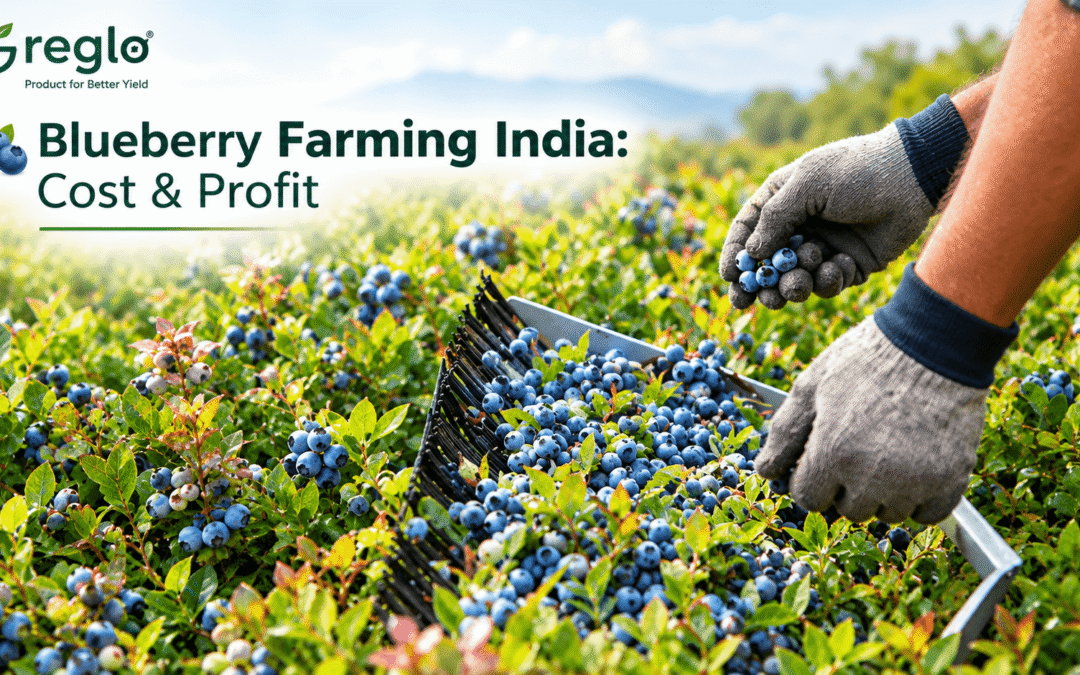
Blueberry farming in India is attracting interest from growers looking for high-value fruit crops and opportunities in premium fresh-produce markets. However, blueberries require more careful planning than many conventional fruit crops, particularly when it comes to soil acidity, water management, planting material, climate, and post-harvest handling.
For commercial growers, profitability depends on much more than the selling price of berries. Variety selection, plant density, irrigation, growing medium, labor, yield, fruit quality, and market access all influence the final return.
What Is Blueberry Farming in India?
Blueberry farming in India involves growing blueberry plants under conditions that support their specific root-zone and climatic requirements.
Unlike crops that perform well in ordinary agricultural soil, blueberries generally require an acidic root environment, good drainage, consistent moisture, and adequate aeration. This makes soil and growing-medium preparation an important part of commercial planning.
For growers considering a new plantation, the first step should be evaluating:
-
-
- Local climate
- Water quality
- Soil characteristics
- Soil pH
- Variety suitability
- Availability of quality planting material
- Market access
- Labor and infrastructure
- Expected production costs
-
Soil testing should be part of the planning process before major fertilizer or soil amendments are applied. ICAR has also emphasized soil testing as the basis for fertilizer decisions in orchard management. (Indian Council of Agricultural Research)
Popular Blueberry Varieties in India
Choosing suitable blueberry varieties in India is one of the most important decisions for a commercial plantation.
Different blueberry types and cultivars can vary in chilling requirement, fruiting period, plant size, yield potential, and adaptation to local growing conditions. Therefore, growers should not select a variety simply because it performs well in another country or region.
When evaluating blueberry plants in India, consider:
🍇 Low-Chill Varieties
Low-chill blueberry types can be particularly relevant when growers are considering warmer regions because they generally require less winter chilling than traditional high-chill types.
However, actual suitability should be confirmed with the nursery, horticultural expert, or research institution for the intended location.
🍇 Variety Selection Checklist
Before purchasing plants, check:
-
-
- Chilling requirement
- Expected harvest period
- Fruit size and quality
- Yield characteristics
- Climate suitability
- Pollination requirements
- Disease considerations
- Availability of certified planting material
-
The National Horticulture Board maintains a national nursery portal that can help buyers identify registered nursery resources and planting-material suppliers.
Where Can Blueberries Be Grown in India?
The suitability of a location depends on the interaction between cultivar, climate, water, soil, and production system.
Potential growing regions should therefore be evaluated individually rather than assuming that an entire state is automatically suitable.
For blueberry cultivation in India, growers should assess:
-
-
- Temperature pattern
- Winter chilling
- Summer heat
- Rainfall
- Water availability
- Irrigation-water quality
- Soil pH
- Drainage
- Availability of skilled labor
- Distance to premium markets
-
Commercial growers in warmer areas may also consider protected or container-based production systems where appropriate.
Why Soil and pH Matter in Blueberry Farming?
Soil management can significantly influence blueberry establishment and long-term plant performance.
Blueberries prefer an acidic root-zone environment. Therefore, checking the starting soil and water conditions before plantation development is essential.
For detailed information on the ideal root-zone conditions, see our guide to blueberry soil pH.
A commercial grower should evaluate:
-
-
- Soil pH
- Drainage
- Organic matter
- Root-zone aeration
- Irrigation-water pH and quality
- Salinity
- Nutrient availability
-
Where native soil is unsuitable, growers may explore raised beds, containers, or engineered growing media instead of trying to force blueberries into unsuitable soil.
Can Coco Coir Be Used in Commercial Blueberry Farming?
Coco coir can be incorporated into growing systems where improved moisture management and root-zone structure are required.
Its usefulness depends on the complete growing-medium formulation rather than coco coir alone.
For commercial production, growers should consider:
-
-
- Coco coir quality
- EC
- Moisture content
- Particle structure
- Drainage
- Aeration
- Buffering requirements
- Compatibility with irrigation and fertigation
-
A properly designed growing medium can help create a more controlled root environment, particularly in containers and raised production systems.
For more information, read our guide to soil mix for blueberries.
Blueberry Plantation Setup Requirements
A commercial blueberry farm requires more than planting seedlings in prepared soil.
Depending on the production model, the initial setup may include:
-
-
- Quality blueberry plants
- Land preparation
- Raised beds or containers
- Growing medium
- Irrigation system
- Fertigation equipment
- Mulching
- Drainage infrastructure
- Support structures where required
- Harvest crates
- Sorting and packing facilities
- Cold-chain or short-term storage arrangements
-
The exact infrastructure will depend on whether blueberries are grown directly in the ground, on raised beds, or in containers.
Blueberry Production Per Acre
Blueberry production per acre depends on several variables rather than acreage alone.
Important factors include:
-
-
- Variety
- Plant age
- Planting density
- Pollination
- Climate
- Root-zone management
- Irrigation
- Nutrition
- Pruning
- Pest and disease management
- Harvest losses
- Fruit quality
-
Young plants should not automatically be compared with mature commercial plantations. A realistic farm model should estimate production year by year as plants establish and reach productive maturity.
How to Calculate Blueberry Farming Profit
Blueberry farming profit should be calculated from actual farm assumptions rather than a single advertised figure.
A simple calculation is:
Gross Revenue = Marketable Yield × Average Selling Price
Then:
Net Profit = Gross Revenue − Total Production Costs
For example, if a farm eventually produces a certain quantity of marketable berries per acre, the grower should calculate revenue using a realistic average selling price rather than the highest retail price observed in the market.
The calculation should also account for:
-
-
- Grade-wise selling prices
- Direct vs wholesale sales
- Harvest losses
- Packaging
- Transportation
- Labor
- Marketing commissions
- Post-harvest losses
-
This gives a more realistic picture of blueberry farming profit per acre.
Common Mistakes in Blueberry Farming
Before investing in commercial blueberry cultivation in India, avoid these common mistakes:
-
-
- Selecting varieties without checking local suitability
- Ignoring soil and irrigation-water testing
- Using unsuitable soil without modifying the root zone
- Choosing plants only on the basis of price
- Underestimating irrigation requirements
- Assuming maximum yield from young plants
- Calculating profit using retail prices only
- Ignoring harvesting and packaging costs
- Planting without a clear market strategy
- Underestimating the importance of post-harvest handling
-
Conclusion
Blueberry farming in India can be approached as a specialized high-value horticultural enterprise, but successful commercial production requires careful planning.
The key is to evaluate the complete system—not just the potential selling price. Variety selection, climate, blueberry soil pH, growing medium, irrigation, plant quality, production maturity, labor, and market access all need to work together.
For growers considering commercial production, start with site and water testing, identify suitable varieties, prepare a realistic blueberry cultivation cost model, and calculate potential returns using conservative production and selling-price assumptions.
For the growing-medium side of production, explore our guides on blueberry soil pH, soil mix for blueberries, and growing blueberries in grow bags before finalizing the farm setup.