
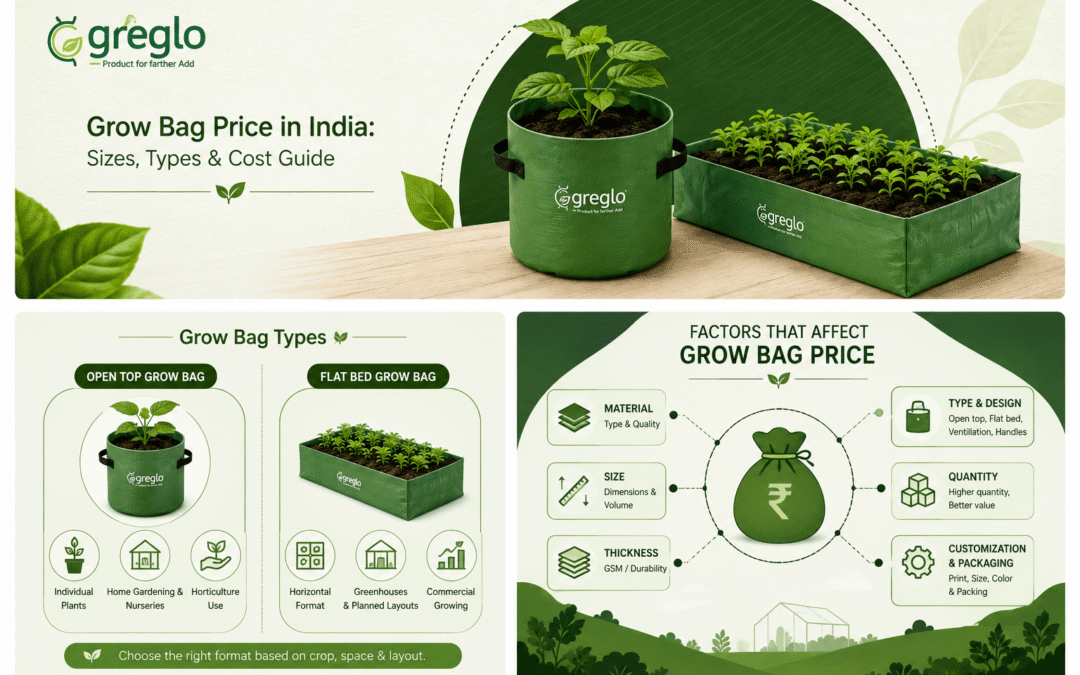
Understanding Grow Bag Price in India
If you are planning to buy grow bags for home gardening, nurseries, greenhouses or commercial cultivation, understanding grow bag price can help you make a more informed purchasing decision.
Grow bag cost is not determined by size alone. Material, thickness, design, quantity, customization, packaging and transportation can all affect the final quotation.
The price of two grow bags that appear similar may differ because their specifications are different. One may use a different material, have a different thickness, offer a different growing volume or be manufactured for a different application.
Therefore, instead of looking for one fixed price, buyers should compare grow bags based on equivalent specifications.
This guide explains the major factors affecting grow bag price in India and how to compare supplier quotations before placing an order.
What Determines Grow Bag Price in India?
There is no single fixed price for every grow bag. The final quotation depends on the product specification and purchasing requirements.
The main factors include:
- Material
- Bag dimensions
- Thickness or GSM
- Design
- Growing volume
- Quantity ordered
- Customization
- Packaging
- Transportation
- Supplier specifications
For this reason, buyers should provide the supplier with clear requirements before requesting a quotation.
A quotation for a small standard grow bag should not be directly compared with a quotation for a larger, heavier or customized product.
Grow Bag Price by Size
Size is one of the most important factors affecting grow bag price.
A larger bag generally requires more material and may also hold a greater quantity of growing medium. As a result, larger bags can have a higher price per unit than smaller bags.
However, price should always be considered together with the intended crop.
1. Smaller Grow Bags
Smaller bags may be appropriate for plants with relatively limited root-space requirements or for certain nursery applications.
They can be useful where:
- Space is limited
- Plants are small
- Individual containers are required
- Growing-medium requirements are lower
2. Medium Grow Bags
Medium-sized grow bags for plants can provide additional growing volume for plants that require more root space.
They may be considered for:
- Vegetables
- Flowering plants
- Larger nursery plants
- Selected horticultural applications
3. Larger Grow Bags
Larger bags can accommodate greater growing-medium volume and may be suitable for larger plants or specific commercial applications.
When buying larger bags, buyers should consider not only the price of the bag but also the additional growing medium, handling requirements and available growing space.
Compare Specification, Not Just Dimensions
|
Specification |
What to Check |
|
Length |
Exact measurement |
|
Width |
Exact measurement |
|
Height |
Exact measurement |
|
Growing volume |
Approximate usable volume |
|
Material |
Type and specification |
|
Thickness |
Thickness/GSM where applicable |
|
Drainage |
Hole design and placement |
|
Quantity |
Number of bags quoted |
How Material Affects Grow Bag Cost
Material is another important factor when evaluating grow bag price.
Grow bags can be produced using different types of materials depending on the intended application.
The material can affect:
- Manufacturing cost
- Weight
- Flexibility
- Handling
- Durability
- Outdoor suitability
- Expected service conditions
Instead of asking only "How much does the grow bag cost?", commercial buyers should ask:
What material specification is included in the quoted price?
This provides a better basis for comparison.
For outdoor or greenhouse applications, buyers may also need to ask whether the product is suitable for the expected exposure to sunlight, moisture and repeated handling.
Does Thickness Affect Grow Bag Price?
Yes. Where thickness or GSM is part of the product specification, it can influence the amount of material used and therefore the overall cost.
A heavier specification may cost more than a lighter one.
However, higher material weight should not automatically be interpreted as being better for every application.
The correct specification depends on:
- Crop
- Growing environment
- Expected handling
- Bag size
- Duration of use
- Cultivation system
For commercial purchasing, ask the supplier to specify the material thickness or GSM clearly on the quotation.
This makes future purchases easier to compare.
Open Top Grow Bag Price Factors
Open top grow bags are individual growing containers with an open upper section for placing the growing medium and plant.
The price of an open top bag can depend on:
- Dimensions
- Material
- Thickness
- Drainage design
- Handles or other features, if applicable
- Order quantity
- Customization
For home gardeners, a smaller order may be the priority.
For nurseries or commercial growers, the focus may instead be on consistent specifications across a larger quantity.
Therefore, when comparing the price of open top bags, make sure the products being compared have similar dimensions and material specifications.
Flat Bed Grow Bag Price Factors
Flat bed grow bags use a horizontal format that can be suitable for certain greenhouse and commercial growing arrangements.
Their pricing can depend on:
- Length
- Width
- Material
- Thickness
- Growing-medium capacity
- Drainage configuration
- Quantity
- Customization
----> Because flat bed bags can be designed for specific cultivation layouts, buyers should clearly communicate their required dimensions and growing arrangement to the supplier.
---->For commercial projects, it is useful to calculate the cost in relation to the number of plants or the growing area rather than looking only at the cost of each bag.
How Order Quantity Affects Grow Bag Price
Quantity can have an important effect on the quotation received from a supplier.
A buyer ordering a few gardening bags may have different pricing from a nursery or commercial grower purchasing thousands of units.
Bulk orders can involve different considerations such as:
- Production quantity
- Packaging
- Manufacturing schedule
- Transportation
- Customization
- Delivery location
When requesting a bulk quotation, provide the supplier with the expected quantity and specification.
For example:
Required:
Bag type + dimensions + material + quantity + delivery location
Grow Bag Price for Home vs Commercial Buyers
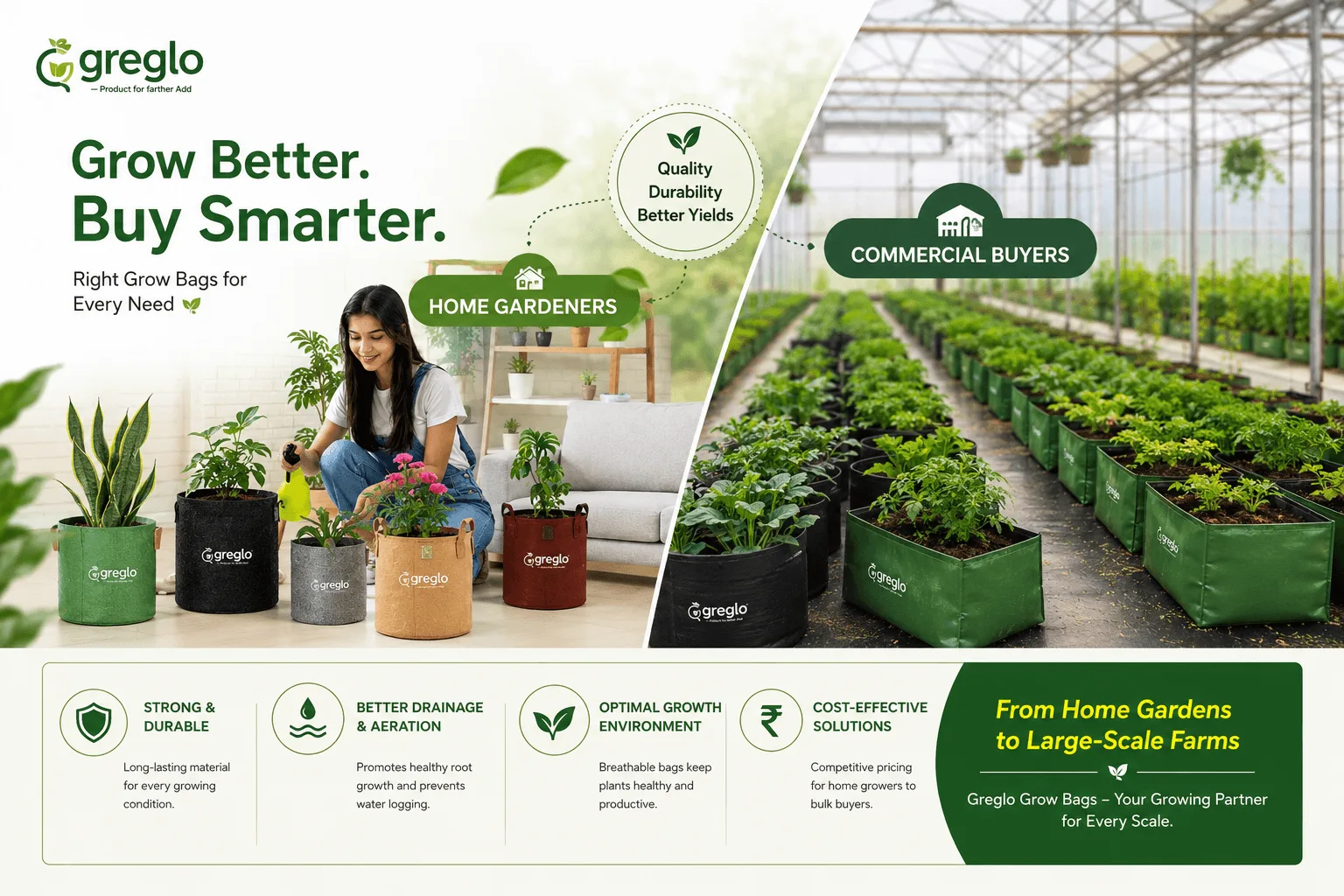
The purchasing priorities of a home gardener are usually different from those of a commercial buyer.
|
Buyer |
Main Considerations |
|
Home gardener |
Size, price, handling, drainage |
|
Nursery |
Consistency, size, quantity, handling |
|
Greenhouse grower |
Layout, crop spacing, irrigation, drainage |
|
Commercial buyer |
Specification, volume, consistency, logistics, total cost |
A home gardener may only need a limited quantity.
A commercial buyer may need thousands of bags and therefore needs to consider the complete delivered cost.
This is why there is no universally applicable grow bag price.
What Is the Total Cost of Buying Grow Bags?
For larger orders, buyers should look beyond the product price.
A simple purchasing calculation is:
Total Delivered Cost = Product Cost + Packaging + Transportation + Other Applicable Charges
Then consider:
Cost Per Usable Grow Bag = Total Delivered Cost ÷ Number of Usable Bags
If bags are supplied with different specifications, also compare their usable growing volume.
This approach can give commercial buyers a more meaningful basis for comparing suppliers.
How to Reduce Grow Bag Purchasing Costs
Commercial buyers can take several practical steps to manage purchasing costs.
1. Finalize Specifications Before Ordering
Avoid changing dimensions or material requirements after production has started.
2. Compare Multiple Quotations
Request quotations using the same specification so suppliers can be compared fairly.
3. Consider Bulk Requirements
If you regularly purchase grow bags, discuss your expected volume with suppliers.
4. Review Transportation
For large orders, transportation can significantly influence the final delivered cost.
5. Avoid Over-Specification
Do not automatically choose a heavier or more expensive product if your crop and cultivation environment do not require it.
6. Check Product Consistency
A consistent specification can be more valuable for commercial cultivation than simply finding the lowest initial quotation.
What to Ask a Grow Bag Supplier Before Ordering
Whether you are searching for grow bags near me or contacting an online supplier, ask for clear product information.
Product Questions
- What material is used?
- What are the exact dimensions?
- What is the thickness or GSM?
- What is the approximate growing volume?
- How is drainage provided?
- What applications is the bag designed for?
Commercial Questions
- What is the minimum order quantity?
- What quantity is available?
- Are custom sizes possible?
- What packaging is provided?
- What is the production lead time?
- What are the delivery terms?
- Is transportation included in the quotation?
Conclusion
The grow bag price you see is only one part of the purchasing decision.
Size, material, thickness, drainage, design, quantity, customization, packaging and transportation can all influence the final cost. For commercial buyers, comparing the total delivered cost against equivalent product specifications is more useful than simply choosing the lowest price per bag.
Whether you are purchasing gardening bags for a home garden or large quantities for nursery, greenhouse or commercial cultivation, start by defining your requirements clearly.
Greglo offers Open Top Grow Bags and Flat Bed Grow Bags for different cultivation requirements. Buyers can compare the available formats and select the specification that best matches their crop and growing system.
Looking for grow bags for your cultivation requirements? Explore Greglo's Open Top and Flat Bed Grow Bag options and discuss your required specifications with the supplier.