
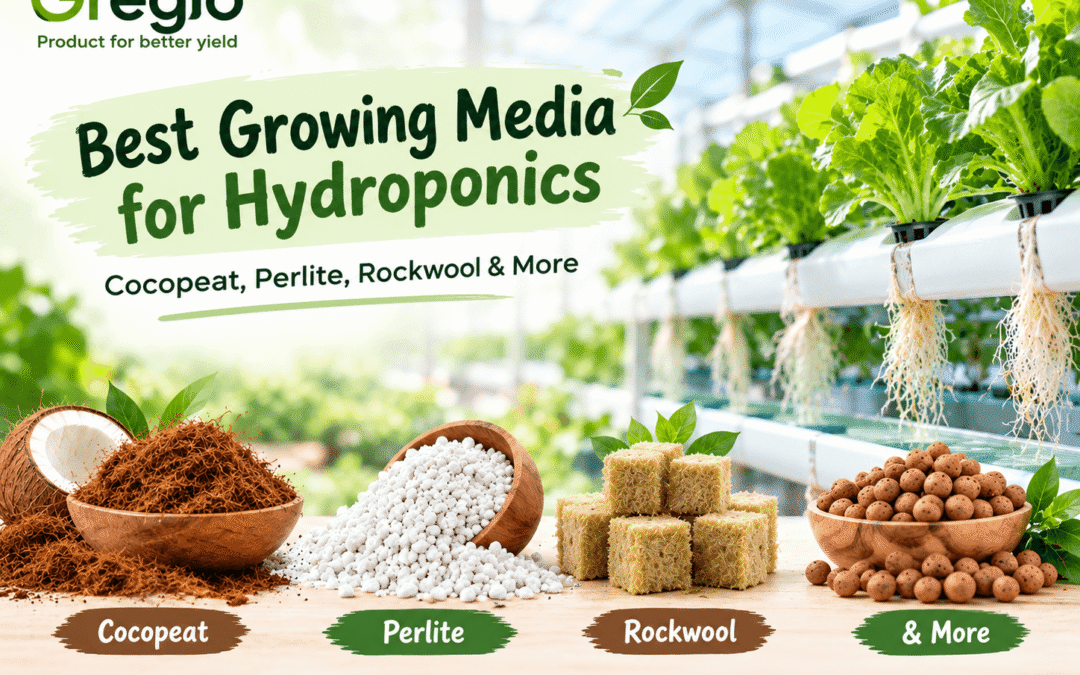
Hydroponic plants grow without traditional garden soil, so choosing the right growing medium is an important part of creating a healthy root environment. The growing medium supports the plant, helps manage moisture, and provides space for roots to receive oxygen.
But what are the best growing media for hydroponics?
There is no single growing medium that works perfectly for every hydroponic system or plant. Cocopeat, perlite, rockwool, clay pebbles, and other materials each have different properties.
In this guide, we’ll look at some of the most commonly used hydroponic growing media, their advantages, limitations, and where they may be useful.
What Is Hydroponic Growing Media?
Hydroponic growing media are materials used to support plant roots in soilless growing systems. Unlike traditional soil, these materials are generally selected for their physical properties rather than their natural nutrient content.
A good hydroponic medium should provide suitable root support while allowing appropriate movement of water and air.
The ideal choice depends on factors such as:
-
-
- Hydroponic system
- Plant type
- Watering or irrigation frequency
- Moisture requirements
- Root aeration
- Availability and cost
- Grower's experience
-
1. Cocopeat
Cocopeat, also known as coco coir, is made from processed coconut husk material. It is widely used in container gardening, nurseries, seed starting, and soilless growing.
🥥 Coconut Husk → 🧱 Processed Cocopeat → 💧 Moisture Retention → 🌱 Root Support → 💚 Hydroponic Growth
One of the main advantages of cocopeat for hydroponics is its ability to retain moisture while providing a lightweight root-supporting environment.
Cocopeat can be particularly useful when plants need consistent moisture. However, because cocopeat is not a complete source of plant nutrition, growers need to provide appropriate nutrients through the hydroponic system.
Benefits of cocopeat
💧 Moisture Retention + ⚖️ Lightweight + 🌱 Root Support + ♻️ Renewable Material → 🌿 Suitable Hydroponic Growing Medium
-
-
- Good moisture retention
- Lightweight
- Useful root support
- Renewable coconut-based material
- Suitable for many soilless systems
-
Considerations
The quality of cocopeat can vary. Proper preparation and suitable nutrient management are important when using it in hydroponic growing.
🔍 Quality Check + 🧪 Nutrient Management → ✅ Better Hydroponic Performance
2. Perlite
Perlite is a lightweight, porous material produced by heating volcanic glass. It is commonly used to improve aeration and drainage.
For growers looking for perlite for hydroponics, its main advantage is the amount of air space it can provide around roots.
Perlite does not retain as much water as cocopeat, so it may be more suitable for systems where irrigation is frequent or where strong drainage and aeration are important.
Benefits of perlite
-
-
- Excellent aeration
- Good drainage
- Lightweight
- Useful for propagation
- Suitable for soilless systems
-
Considerations
Perlite can be dusty when handled. Its low water-retention capacity may also make it less suitable as the only medium in systems where moisture availability is limited.
🌋 Perlite → 🫧 Air Spaces → 💨 Aeration → 💧 Drainage → 🌱 Healthy Roots
3. Rockwool
Rockwool is a manufactured growing material made from mineral fibers. It is commonly used for seed starting and hydroponic cultivation.
Its structure allows it to hold moisture while maintaining air spaces around roots.
Rockwool is available in different forms, including starter cubes and larger slabs designed for hydroponic production.
Benefits of rockwool
-
-
- Good moisture retention
- Good root support
- Useful for seed starting
- Available in standardized sizes
- Commonly used in commercial hydroponics
-
Considerations
Rockwool requires careful handling and appropriate preparation. Growers also need to manage moisture and nutrient conditions according to the requirements of the plants.
4. Clay Pebbles / LECA
Clay pebbles, often called LECA, are lightweight expanded clay pellets used in various hydroponic systems.
They provide physical support while creating air spaces around plant roots. Because they do not hold as much water as cocopeat, they are often used in systems where roots receive water regularly.
Benefits of clay pebbles
-
-
- Excellent drainage
- Good aeration
- Reusable when properly cleaned
- Provide strong physical support
- Suitable for several hydroponic systems
-
🟤 Clay Pebbles / LECA → 💨 Air Spaces → 💧 Fast Drainage → 🌱 Root Support → ♻️ Reusable → 🌿 Healthy Growth
Considerations
Clay pebbles require cleaning and preparation before reuse. They may also need more frequent irrigation depending on the system.
Best Growing Media for Hydroponics Compared
|
Growing Medium |
Water Retention |
Aeration |
Main Use |
|
Cocopeat |
High |
Good |
Moisture retention and root support |
|
Perlite |
Low |
Excellent |
Drainage and aeration |
|
Rockwool |
High |
Good |
Seed starting and hydroponic production |
|
Clay pebbles |
Low |
Excellent |
Root support and drainage |
|
Vermiculite |
High |
Moderate |
Propagation and moisture retention |
Cocopeat vs Perlite for Hydroponics
One of the most common comparisons is cocopeat vs perlite for hydroponics.
Cocopeat holds more moisture, while perlite provides greater air space and drainage. This makes them useful for different growing conditions.
Cocopeat may be useful when maintaining moisture around roots is a priority. Perlite can be useful when increased drainage and aeration are more important.
They can also be combined.
A cocopeat-perlite mix can provide a balance between moisture retention and aeration, although the appropriate proportion depends on the plant and growing system.
Cocopeat and Perlite Mix for Hydroponics
Combining growing media can sometimes provide advantages over using a single material.
A cocopeat and perlite combination can provide:
-
-
- Moisture retention from cocopeat
- Increased aeration from perlite
- Improved drainage
- Lightweight root support
-
The exact cocopeat perlite ratio should not be treated as a universal formula. Consider the plant, irrigation frequency, climate, container size, and hydroponic system before choosing a ratio.
Cocopeat and Perlite Mix for Hydroponics
Combining growing media can sometimes provide advantages over using a single material.
A cocopeat and perlite combination can provide:
-
-
- Moisture retention from cocopeat
- Increased aeration from perlite
- Improved drainage
- Lightweight root support
-
The exact cocopeat perlite ratio should not be treated as a universal formula. Consider the plant, irrigation frequency, climate, container size, and hydroponic system before choosing a ratio.
How to Choose the Best Hydroponic Growing Medium
When choosing the best growing medium for hydroponics, consider these factors:
1. Water Requirements
Plants that need consistent moisture may benefit from materials with higher water retention.
2. Aeration
Plants need oxygen around their roots. Materials such as perlite and clay pebbles can create substantial air spaces.
3. Hydroponic System
Different systems have different requirements. A medium suitable for one system may not work as effectively in another.
4. Plant Type
Leafy greens, herbs, vegetables, and fruiting plants can have different root and moisture requirements.
5. Nutrient Management
Most hydroponic growing media provide little or no nutrition. Plants depend on the nutrient solution for essential nutrients.
6. Cost and Availability
A practical growing medium should also be affordable and readily available in your location.
Best Growing Media for Beginners
For beginners, there is no universal "best" choice. Cocopeat can be relatively easy to work with when moisture retention is useful, while clay pebbles can be convenient in systems that provide frequent access to nutrient solution.
Perlite can be useful when drainage and aeration are priorities, while rockwool is commonly used for starting seeds and young plants.
Understanding your hydroponic system first is more important than simply choosing the most popular medium.
Frequently Asked Questions
1. What is the best growing medium for hydroponics?
There is no single best medium for every hydroponic system. Cocopeat, perlite, rockwool, clay pebbles, and other materials can all be useful depending on the plant and system.
2. Is cocopeat good for hydroponics?
Yes. Cocopeat for hydroponics can provide moisture retention and root support. It should be used with appropriate nutrient management because cocopeat is not a complete source of plant nutrition.
3. Is perlite good for hydroponics?
Yes. Perlite for hydroponics can provide excellent aeration and drainage. It is particularly useful in systems where frequent irrigation is available.