
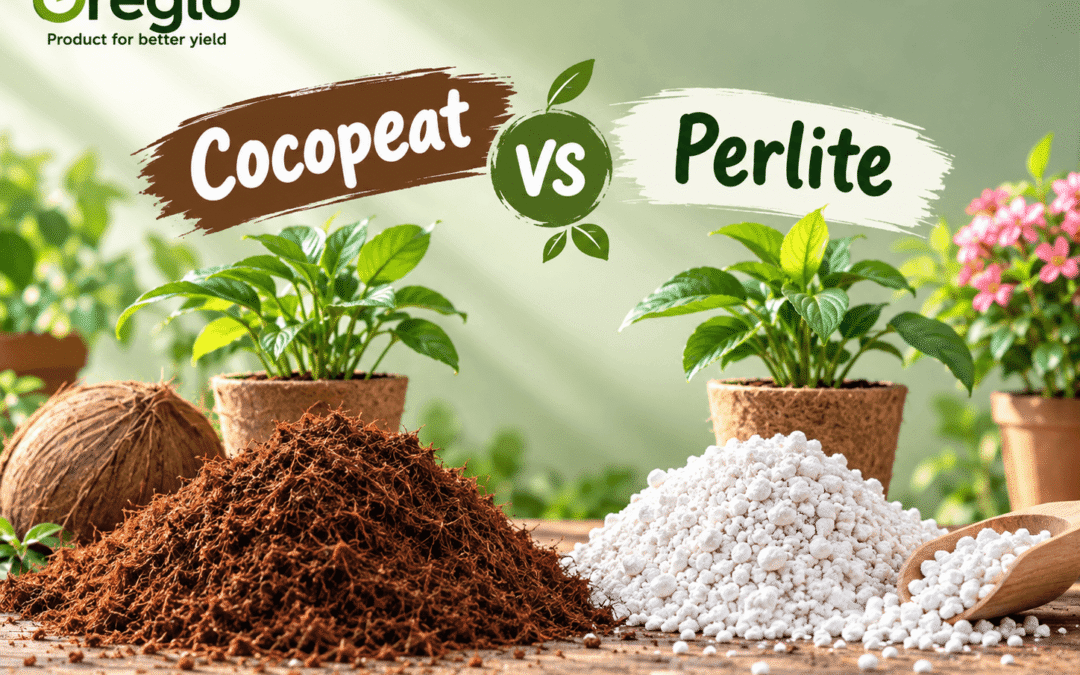
Choosing the right growing medium can make a big difference in how well plant roots receive water, oxygen, and nutrients. Cocopeat and perlite are two popular materials used in gardening, container plants, nurseries, and soilless growing systems.
But when comparing cocopeat vs perlite, which one is better for plant growth?
The answer depends on what your plants need. Cocopeat is known for its moisture-retention properties, while perlite is widely used to improve drainage and aeration. In many growing situations, they can also be used together.
In this guide, we'll compare cocopeat and perlite based on water retention, drainage, aeration, nutrients, weight, and practical uses.
What Is Cocopeat?
Cocopeat, also called coco coir, is a growing medium made from processed coconut husk fiber. It is commonly sold as loose material or compressed blocks and bricks that expand after being hydrated.
One of the main benefits of cocopeat for plants is its ability to hold moisture while maintaining air spaces around the roots. Its lightweight structure makes it useful for container gardening, seed starting, nurseries, and soilless growing.
However, cocopeat is not a complete source of plant nutrients. Plants grown mainly in cocopeat generally need an appropriate supply of nutrients.
What Is Perlite?
Perlite is a lightweight material made by heating volcanic glass at high temperatures. The process causes it to expand into small, porous particles.
Perlite is mainly used to improve drainage and aeration in growing mixes. Its porous structure creates spaces that allow air and excess water to move through the root zone.
Unlike compost or nutrient-rich soil, perlite does not provide significant plant nutrition. It is primarily used to improve the physical properties of a growing medium.
Cocopeat vs Perlite: Key Differences
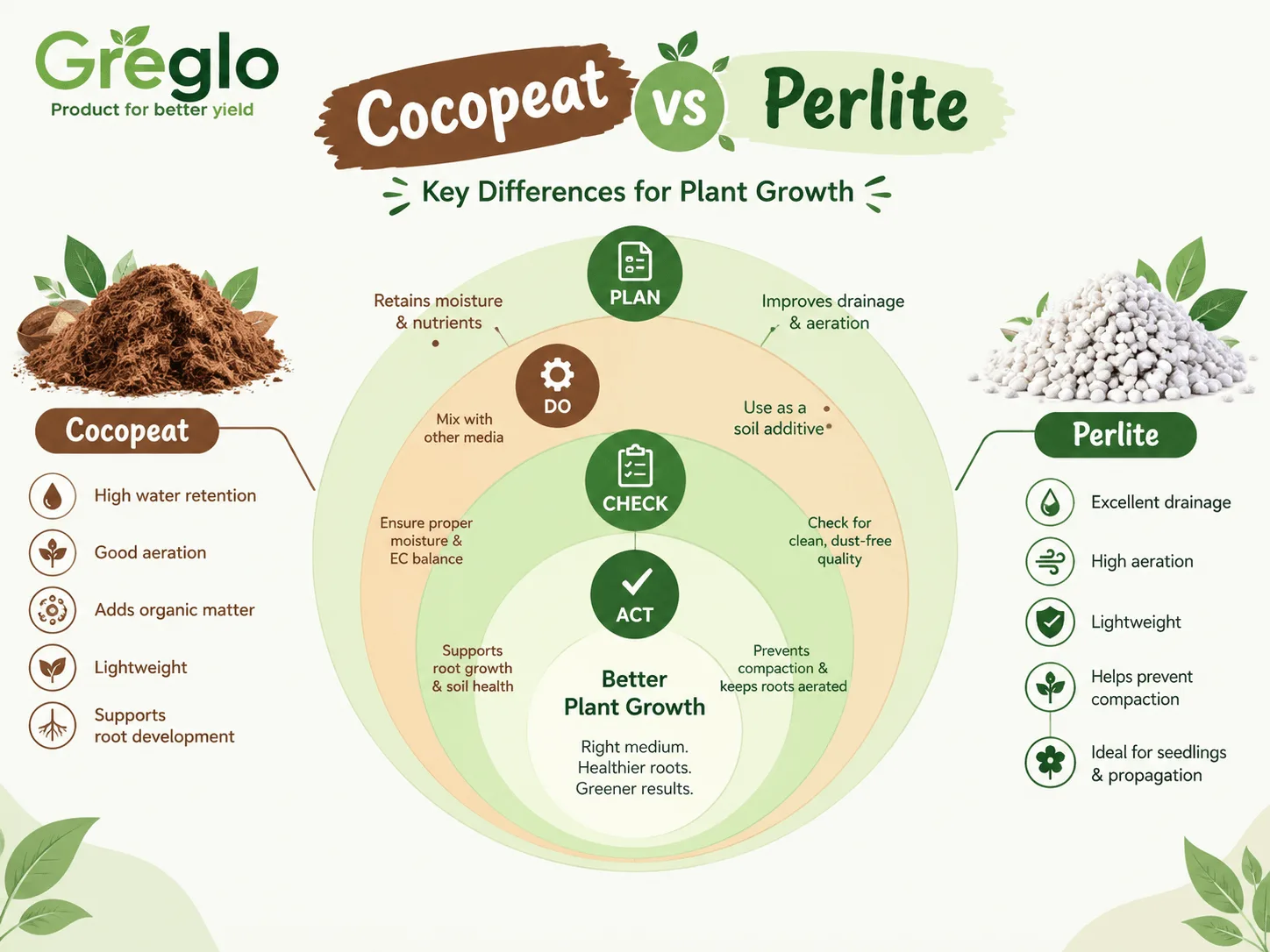
When looking at cocopeat vs perlite, the biggest difference is how each material manages water and air around plant roots.
|
Feature |
Cocopeat |
Perlite |
|
Water retention |
High |
Low |
|
Drainage |
Good when properly mixed |
Excellent |
|
Aeration |
Good |
Excellent |
|
Weight |
Lightweight |
Very lightweight |
|
Nutrient content |
Limited by itself |
Very low |
|
Main function |
Moisture retention |
Drainage and aeration |
|
Organic material |
Yes, coconut-based |
No |
|
Common use |
Potting mixes and soilless growing |
Potting mixes and propagation |
Water Retention
Water management is one of the clearest differences between cocopeat and perlite.
Cocopeat can absorb and retain a considerable amount of water. Its fibrous structure allows it to hold moisture while still maintaining some air spaces around the roots.
Perlite behaves differently. It holds relatively little water compared with cocopeat and is mainly used to create air spaces and improve drainage.
If a growing mix dries out too quickly, adding cocopeat can help increase moisture retention. If a mix stays too wet, perlite can help improve drainage and aeration.
Drainage and Aeration
Plant roots require oxygen as well as water. A growing medium that remains waterlogged can limit the oxygen available to roots.
Perlite is particularly useful for increasing air spaces within a growing mix. Its porous particles help excess water move away from the root zone.
Cocopeat also provides useful aeration because of its fibrous structure, but its stronger moisture-retention ability makes it different from perlite.
This is why growers often combine the two materials rather than choosing only one.
Cocopeat vs Perlite for Plant Roots
Healthy root development depends on the balance between moisture and oxygen.
Cocopeat provides a moist environment that can be useful for plants that do not tolerate rapid drying. Perlite helps create additional air spaces and improves drainage.
For this reason, the choice between cocopeat vs perlite for plants should be based on the moisture and drainage requirements of the particular plant.
Plants that prefer a more moisture-retentive growing environment may benefit from cocopeat, while plants that require excellent drainage may benefit from a growing mix containing more perlite.
Nutrient Availability
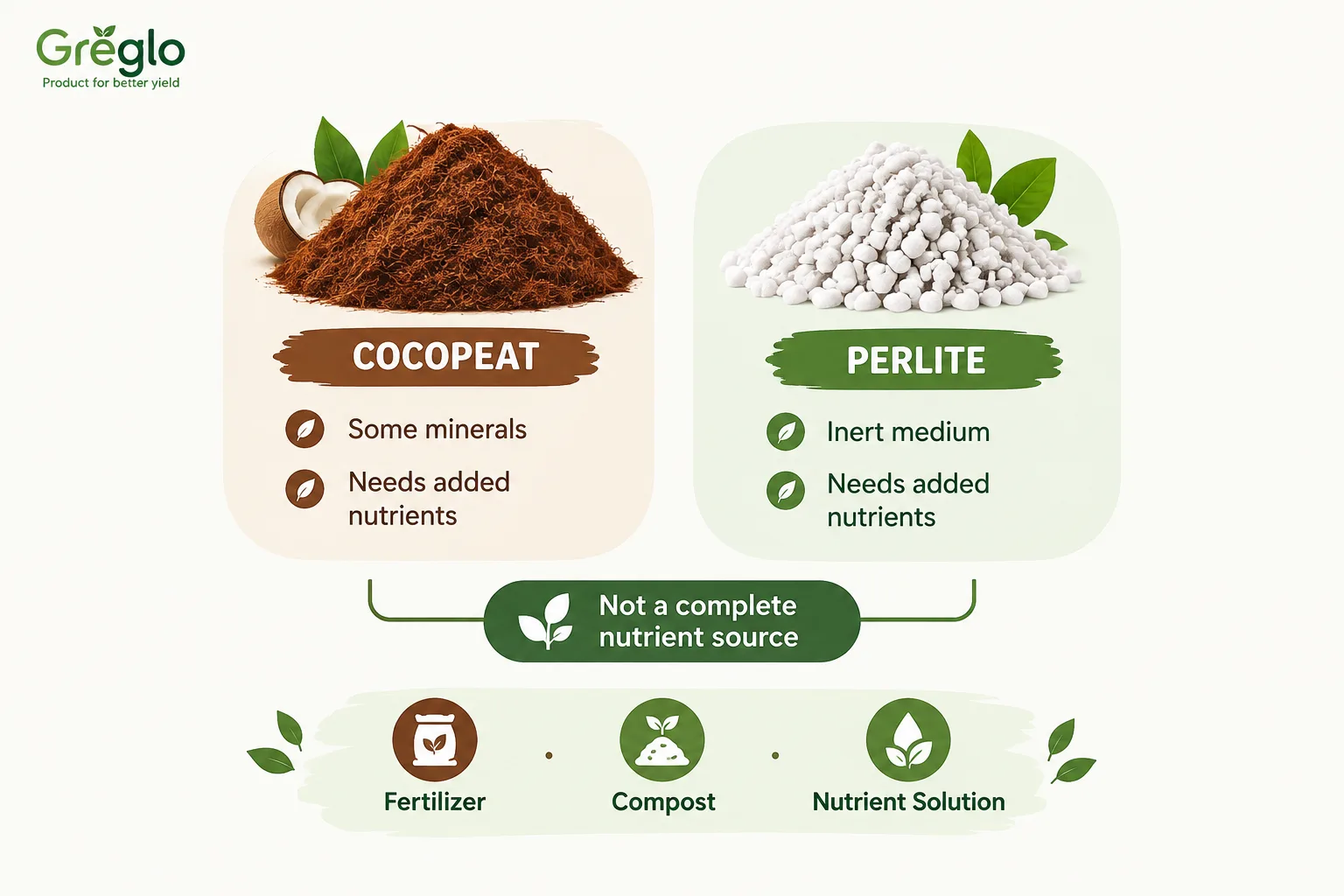
Neither cocopeat nor perlite should be considered a complete source of plant nutrition.
Cocopeat may contain small amounts of naturally occurring minerals depending on its source and processing, but plants grown primarily in cocopeat generally require additional nutrients.
Perlite is mainly an inert physical component. It does not provide the nutrients plants need for healthy growth.
In both cases, nutrients need to come from suitable fertilizers, compost, nutrient solutions, or other components of the growing system.
Cocopeat and Perlite Mix
One of the most useful options is to combine both materials.
A cocopeat and perlite mix can provide a balance between moisture retention and drainage. Cocopeat helps hold moisture, while perlite creates additional air spaces and allows excess water to drain more easily.
The appropriate ratio depends on the plant, container, climate, watering frequency, and other components in the growing medium.
There is no universal ratio that works for every plant.
For example, a plant that needs more moisture may benefit from a mix containing more cocopeat, while a plant that requires very good drainage may need a greater proportion of perlite.
Cocopeat vs Perlite for Hydroponics
Both materials can be used in hydroponic and soilless growing systems, although they perform different functions.
Cocopeat vs perlite for hydroponics is often a question of moisture management versus aeration.
Cocopeat can retain moisture and provide a root-supporting structure. Perlite provides excellent air spaces and drainage.
Some growers combine cocopeat and perlite to create a growing medium that balances water retention and root-zone aeration.
The appropriate medium also depends on the hydroponic system, irrigation frequency, plant type, and nutrient-management method.
Weight and Handling
Both cocopeat and perlite are lightweight compared with traditional garden soil.
Cocopeat is particularly convenient because compressed cocopeat blocks can be stored and transported efficiently before being hydrated.
Perlite is also lightweight, making it useful for container mixes where reducing the overall weight is important.
However, perlite particles can be dusty when handled, so care should be taken to avoid inhaling the dust during preparation.
Which Is Better for Different Plants?
There is no single answer to which material is better for every plant.
Cocopeat may be useful for:
-
-
- Seed starting
- Container gardening
- Nursery plants
- Plants requiring good moisture retention
- Soilless growing
- Some hydroponic systems
-
Perlite may be useful for:
-
-
- Plants requiring excellent drainage
- Succulents and cacti when used as part of a suitable mix
- Propagation
- Container growing
- Improving aeration in heavy growing mixes
- Hydroponic and soilless systems
-
The final growing medium should always be selected according to the plant's moisture, drainage, and root requirements.
Can You Use Cocopeat and Perlite Together?
Yes. In fact, using both can be a practical way to balance the properties of the growing medium.
Cocopeat helps retain moisture, while perlite improves drainage and creates additional air spaces.
A cocopeat perlite ratio should not be treated as a fixed formula for every plant. The right proportion depends on the plant species, growing environment, container size, watering schedule, and other ingredients in the mix.
Instead of following one universal ratio, adjust the mix according to whether your plants need more moisture retention or better drainage.
Cocopeat vs Perlite: Which One Should You Choose?
The choice between cocopeat vs perlite depends primarily on what your growing medium needs.
Choose cocopeat when moisture retention and a lightweight growing medium are important.
Choose perlite when improving drainage and aeration is the main goal.
In many cases, you don't have to choose only one. Combining cocopeat and perlite can provide both moisture retention and improved aeration.
The most suitable growing medium is the one that provides the right balance of water, air, drainage, root support, and nutrients for your particular plant.
Frequently Asked Questions
1. Is cocopeat better than perlite?
Neither is universally better. Cocopeat is better suited to situations where moisture retention is important, while perlite is primarily used to improve drainage and aeration. They can also be combined.
2. Can I mix cocopeat and perlite?
Yes. A cocopeat and perlite mix can provide a balance between moisture retention and aeration. The appropriate proportion depends on the plant and growing conditions.
3. What is the difference between cocopeat and perlite?
Cocopeat is a coconut-based growing material that retains moisture, while perlite is a lightweight volcanic material primarily used to improve drainage and aeration.