
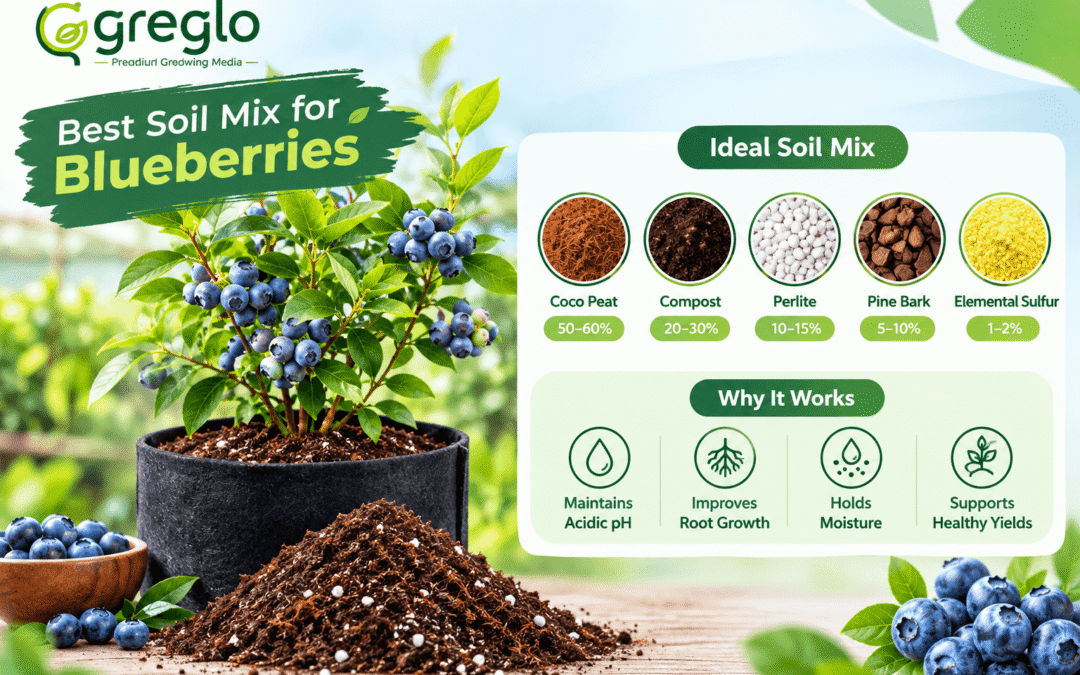
Growing blueberries successfully starts with more than choosing a healthy plant. The soil mix for blueberries needs to provide the right balance of acidity, moisture, drainage, and root-zone aeration.
Unlike many garden plants, blueberries prefer an acidic growing environment. A suitable blueberry soil mix can help create better conditions for nutrient availability and root development, especially when blueberries are grown in containers or grow bags.
In this guide, we'll look at what makes a good blueberry growing medium, how coco coir can be used, and how to check the finished mix before planting.
What Makes a Good Soil Mix for Blueberries?
A good soil mix for blueberries should create a root environment that is:
-
-
- Acidic enough for blueberry plants
- Well drained
- Moisture retentive without staying waterlogged
- Loose enough for root-zone aeration
- Stable enough to support long-term plant growth
-
Blueberries have relatively shallow root systems, so the quality of the growing medium around those roots is particularly important.
The goal is not simply to find the most acidic material. Instead, the complete growing medium should provide a suitable balance of pH, moisture, drainage, and air space.
What pH Should a Blueberry Soil Mix Have?
The blueberry soil pH is one of the most important factors to check before planting.
Blueberries generally prefer an acidic root-zone environment, commonly around pH 4.5–5.5, although the preferred range can vary depending on the cultivar and growing system.
A mix that is too alkaline can reduce the availability of certain nutrients and may contribute to poor plant growth or leaf discoloration.
This is why you should test the finished blueberry potting mix rather than assuming that each individual ingredient has the correct pH.
For a detailed explanation of blueberry pH requirements, see our guide to blueberry soil pH.
Can Coco Coir Be Used in Blueberry Potting Mix?
Yes, coco coir can be incorporated into a blueberry growing medium, particularly for container and controlled growing systems.
Coco coir can contribute useful physical properties such as moisture retention and root-zone structure. However, it should be treated as one component of the overall mix rather than a complete solution for blueberry plants.
When selecting coco coir, consider:
-
-
- pH
- EC
- Moisture
- Particle size
- Drainage
- Air-filled porosity
- Consistency
-
The final growing medium should be tested after all components have been combined.
Why Coco Coir Can Be Useful
A well-structured coco coir component can help the growing medium retain moisture while maintaining useful air space around the roots.
This can be particularly helpful for blueberry plants in pots, where the root zone is limited compared with plants growing directly in the ground.
However, moisture retention should always be balanced with drainage.
Why Drainage Matters for Blueberry Plants
Blueberries need consistent moisture, but that doesn't mean their roots should remain saturated.
Poor drainage can reduce oxygen around the roots and create unfavorable root-zone conditions.
When preparing soil for blueberry plants, check whether excess water can drain freely from the bottom of the container or grow bag.
A practical growing medium should:
-
-
- Hold enough moisture between watering
- Allow excess water to escape
- Maintain air spaces around roots
- Avoid becoming heavily compacted
-
This balance becomes particularly important in warm climates where growers may need to irrigate more frequently.
Root Aeration and Growing-Medium Structure
Root-zone aeration is another important consideration when preparing blueberry potting mix.
A dense or compacted medium can restrict air movement around the roots. On the other hand, a very coarse medium may drain too quickly and make consistent moisture management difficult.
The ideal structure depends on the materials used, container size, irrigation frequency, and local growing conditions.
For commercial or controlled production, growers should evaluate physical properties such as moisture retention and air-filled porosity rather than selecting a mix based only on its appearance.
How to Prepare a Blueberry Growing Medium
There is no single recipe that works for every blueberry cultivar or growing environment.
Instead of following a fixed ratio blindly, build the mix around the plant's requirements.
Step 1: Choose a Suitable Base
Select a clean, consistent growing-medium base that provides the desired structure.
Step 2: Add Moisture-Management Components
Coco coir can be incorporated when additional moisture retention and a suitable root-zone structure are required.
Step 3: Check Drainage
Make sure the finished mix drains excess water without drying excessively quickly.
Step 4: Test the Finished Mix
This is the most important step.
Measure the blueberry plant soil pH after preparing the complete mixture.
If the pH isn't suitable, make controlled adjustments based on the test result rather than adding large quantities of an amendment without measurement.
How to Test Your Blueberry Soil Mix
Testing the finished growing medium gives you a much better indication of the conditions your blueberry roots will actually experience.
1. Before Planting
Test the mix before placing the blueberry plant into the container.
2. After Planting
Continue monitoring the root-zone environment because irrigation water, fertilizers, and other inputs can influence growing-medium conditions.
3. Don't Rely on Leaf Color Alone
Yellow leaves can be associated with several different growing problems. A pH test can help determine whether acidity is actually contributing to the issue.
Common Blueberry Soil-Mix Mistakes
Using Ordinary Garden Soil Without Testing
Garden soil may not have the acidity, drainage, or structure required by blueberries.
Making the Mix Too Acidic
Lower pH is not automatically better. The goal is an appropriate acidic range.
Using Coco Coir Alone
Coco coir can be a useful component, but the complete growing medium needs to meet the plant's requirements.
Ignoring Irrigation Water
Water chemistry can gradually influence the growing-medium environment.
Overwatering
Even a good blueberry soil mix can perform poorly if the container remains saturated.
Changing pH Without Testing
Always test before making major adjustments.
Blueberry Soil Mix Checklist
Before planting, check whether your growing medium provides:
☑️ Suitable blueberry soil pH
☑️ Good drainage
☑️ Consistent moisture retention
☑️ Adequate root-zone aeration
☑️ Suitable structure
☑️ Appropriate EC
☑️ Consistent irrigation
☑️ Regular monitoring
Conclusion
The best soil mix for blueberries is not simply the most acidic mix or the mix containing the most ingredients. It is a growing medium that provides a suitable combination of acidity, moisture, drainage, and aeration for the specific blueberry variety and growing system.
Coco coir can be a useful component in a controlled blueberry growing medium, particularly for container and grow-bag cultivation. However, always evaluate the complete mix and test its pH before planting.
For the best results, focus on the entire root environment rather than one individual ingredient.