
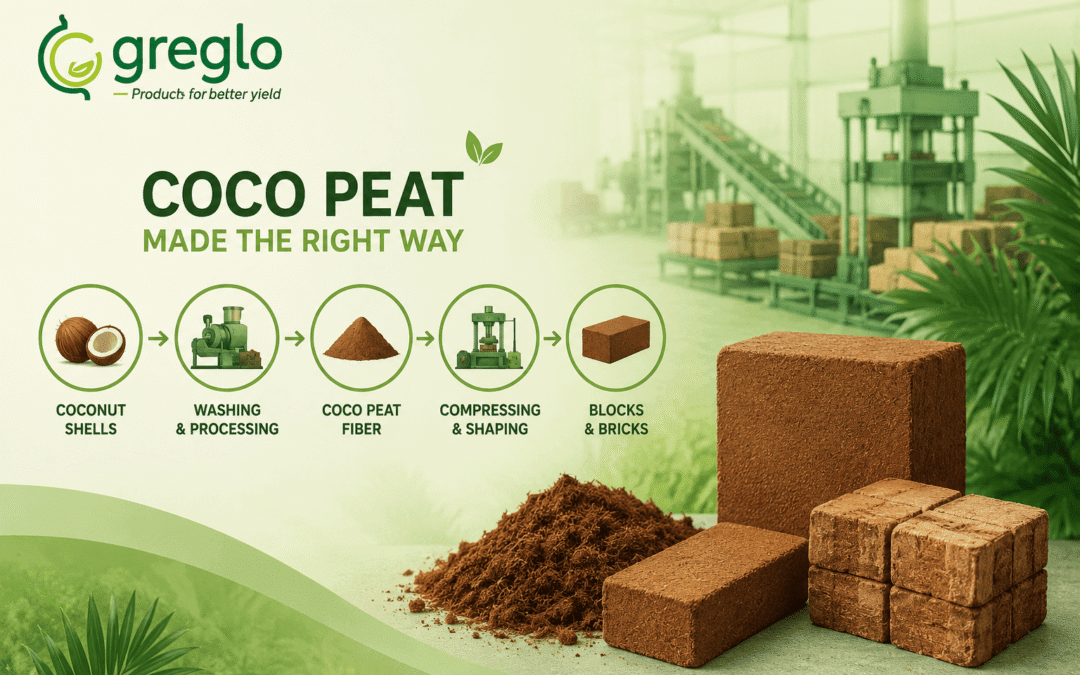
From Coconut Husks to Coco Peat Blocks and Bricks
Coco peat is a natural growing medium made from the fibrous material found inside coconut husks.
It is widely used in nurseries, greenhouses, hydroponics, seed starting, horticulture, and commercial farming because of its water-holding capacity, aeration, and ability to support healthy root development.
But how does raw coconut husk become a compact coco peat brick or block?
The coco peat manufacturing process involves several stages, including coconut husk collection, fibre separation, coir pith processing, screening, washing, drying, quality testing, and compression.
The final material can then be supplied in different formats, including 650g coco peat bricks and 5kg coco peat blocks.
What Is Coco Peat Made From?
Coco peat is produced from coconut husks, which are the outer protective layers of coconuts. During coir processing, the husk is separated into useful fibre and the remaining pith-like material.
This coir pith is processed and refined to produce coco peat suitable for agricultural and horticultural applications.
The quality of the final product depends on factors such as the source of the husk, processing method, moisture level, particle size, EC, pH, cleanliness, and compression.
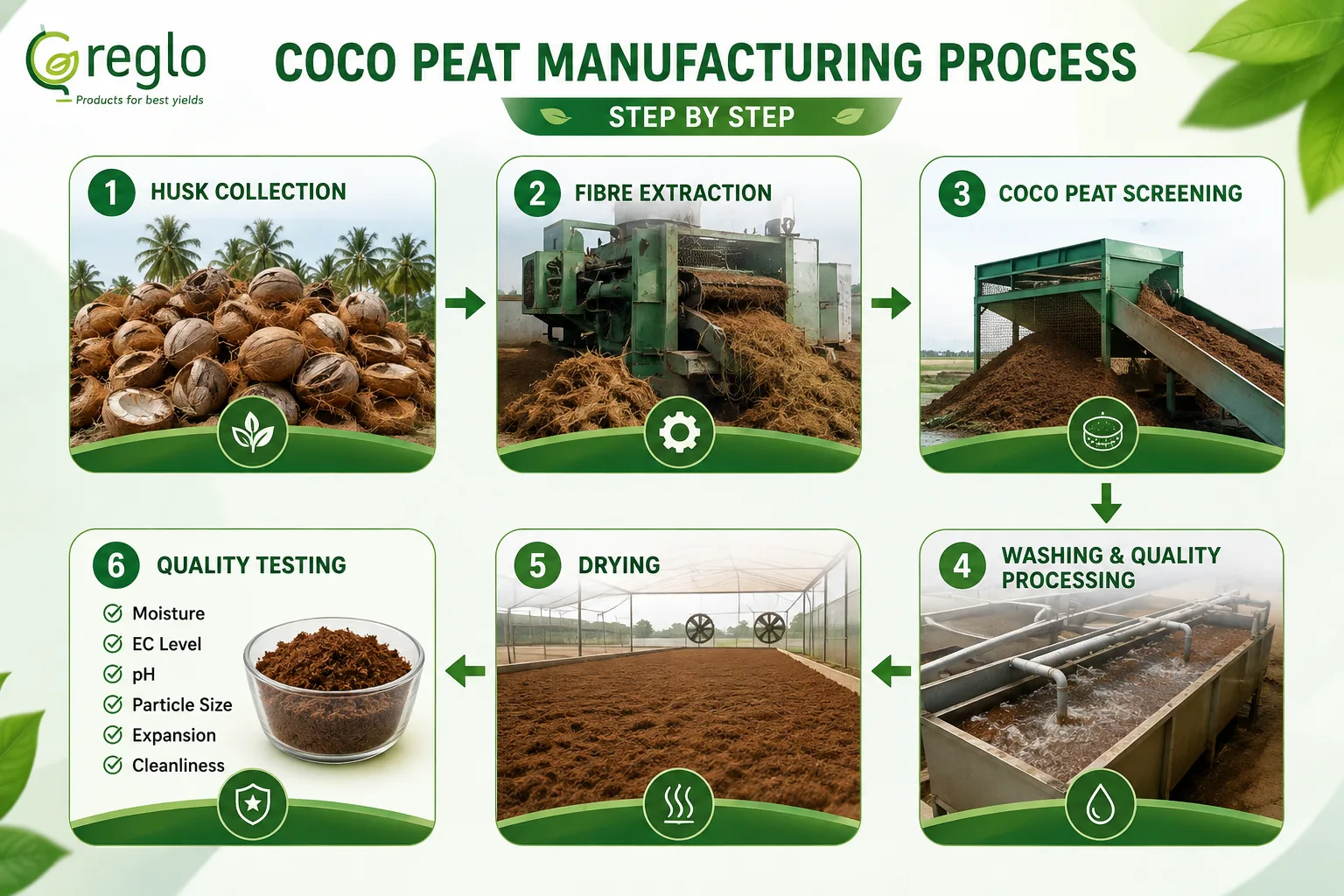
Coco Peat Manufacturing Process: Step by Step
1. Coconut Husk Collection
The manufacturing process begins with the collection of mature coconut husks from coconut-processing areas.
The husks are selected and prepared for mechanical processing. Proper raw-material selection is important because contaminated or poor-quality husks can affect the cleanliness and consistency of the finished coco peat.
2. Fibre Extraction and Coir Processing
The coconut husks are mechanically processed to separate the long coir fibres from the shorter pith material.
The remaining coir pith becomes the primary raw material for coco peat production. This material is then processed further to remove unwanted particles and prepare it for use as a growing medium.
3. Coco Peat Screening
The extracted coir pith is screened to achieve a more consistent particle size.
Screening helps remove oversized fibre pieces, foreign materials, and unwanted particles. Depending on the intended application, manufacturers can process coco peat into different particle-size grades.
Consistent particle size is particularly important for commercial buyers because it can influence aeration, water retention, handling, and root-zone performance.
4. Washing and Quality Processing
Depending on the product specification and intended application, coco peat may undergo washing or buffering processes.
This stage helps manage soluble salts and other naturally occurring materials in the coir pith. EC (electrical conductivity) is commonly checked to evaluate the salt level of the processed material.
Manufacturers may also monitor pH and other quality parameters according to the requirements of the target market.
5. Drying
After processing and washing, the coco peat is dried to reach the required moisture level.
Controlled drying is important because excessive moisture can affect storage, transportation, weight consistency, and compression.
The final moisture specification depends on the product and buyer requirements.
6. Quality Testing
Before compression, the processed coco peat is inspected and tested.
Typical quality checks may include:
- Moisture content
- EC level
- pH
- Particle size
- Expansion capacity
- Fibre content
- Cleanliness
- Compression characteristics
For commercial orders, buyers should request product specifications and, where appropriate, test reports before placing large orders.
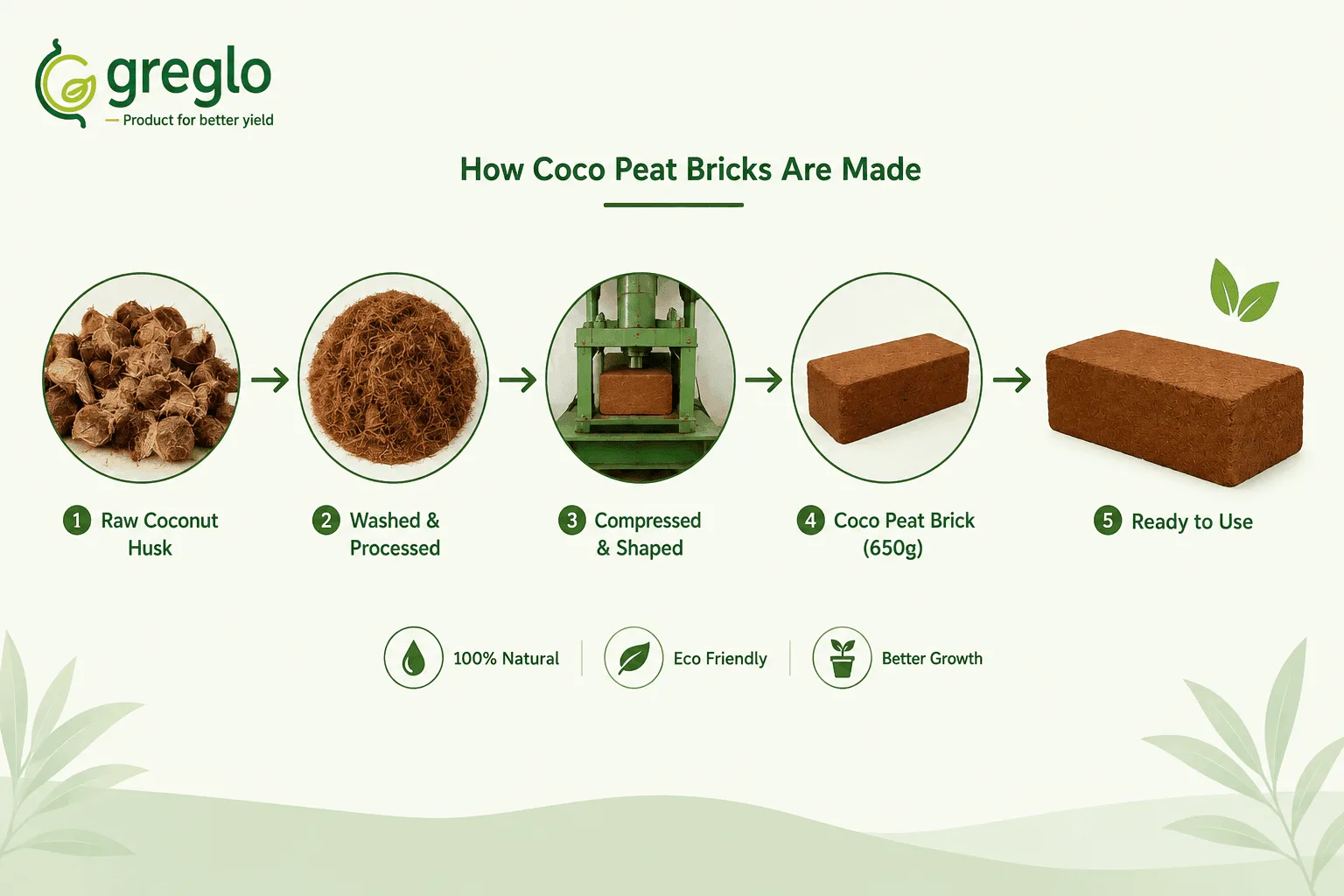
How Are Coco Peat Bricks Made?
After processing and quality checks, coco peat can be compressed into compact bricks.
For a 650g coco peat brick, the processed material is measured according to the required weight and compression specification. It is then placed into a suitable compression machine and compacted into a uniform shape.
The compact format makes the product easier to package, store, transport, and handle.
Once the brick reaches the required compression and dimensions, it is packed according to the buyer's packaging requirements.
After adding water, compressed coco peat expands and becomes a loose growing medium.
How Are 5kg Coco Peat Blocks Made?
The basic process for manufacturing a 5kg coco peat block is similar, but a larger quantity of processed coco peat is compressed into a heavier block.
The material is accurately weighed and fed into a hydraulic or mechanical compression system. The compression pressure is controlled to achieve the required density, dimensions, and stability.
A properly compressed 5kg block should maintain its shape during handling and transportation while still being capable of expanding when hydrated.
Why Compression Matters in Coco Peat Manufacturing
Compression is an important part of coco peat block manufacturing because it reduces the volume of the material for transportation and storage.
A compact product can provide several practical advantages:
- Easier transportation
- Reduced storage space
- Convenient handling
- Better packaging efficiency
- Consistent product weight
- Easier distribution
However, excessive or inconsistent compression can affect how easily the block breaks apart and expands. Therefore, manufacturers need to balance compression with the intended application and product specification.
How Manufacturers Maintain Coco Peat Quality
Reliable coco peat manufacturers generally use defined processing and quality-control procedures throughout production.
Instead of checking only the finished block, quality should be monitored from raw material selection through final packaging.
Important parameters include:
| Quality Factor | Why It Matters |
| EC | Indicates soluble salt level |
| pH | Helps determine suitability for growing applications |
| Moisture | Affects weight, storage and consistency |
| Particle size | Influences aeration and water retention |
| Expansion | Shows the usable volume after hydration |
| Compression | Affects handling and expansion |
| Cleanliness | Helps ensure a suitable growing medium |
| Packaging | Protects the product during storage and transport |
Choosing the Right Coco Peat Manufacturer
For commercial buyers, selecting a manufacturer should involve more than comparing the price per block.
Consider the manufacturer's processing capability, product specifications, quality-control practices, packaging options, production capacity, MOQ, and ability to meet consistent specifications.
Buyers can also compare coco peat manufacturers in India based on their ability to supply the required brick or block format, quality grade, packaging, and order volume.
Conclusion
The coco peat production process transforms coconut husk waste into a useful and renewable growing medium. From husk collection and coir pith separation to screening, washing, drying, testing, and compression, each stage contributes to the quality of the finished product.
Whether you need compact 650g coco peat bricks for retail or 5kg coco peat blocks for larger horticultural applications, understanding the manufacturing process makes it easier to evaluate suppliers and product specifications.
For buyers looking for reliable sourcing options, explore our guide to coco peat manufacturers in India and compare suppliers based on quality, specifications, packaging, and production capabilities.