
Modern growers are increasingly looking for growing media that can manage moisture, support healthy roots, and fit different cultivation systems. Cocopeat has become a practical choice because it is lightweight, renewable, and derived from coconut husk.
But before choosing any cocopeat product, growers need to know more than just its basic definition. What is Cocopeat made from, how does it perform, what types are available, and what should buyers check before using it?
At GREGLO, cocopeat is produced for agricultural and horticultural applications with attention to processing, washing, buffering, and product consistency. Understanding these factors helps growers select the right material for their specific crops and growing conditions.
What Is Cocopeat and Where Does It Come From?
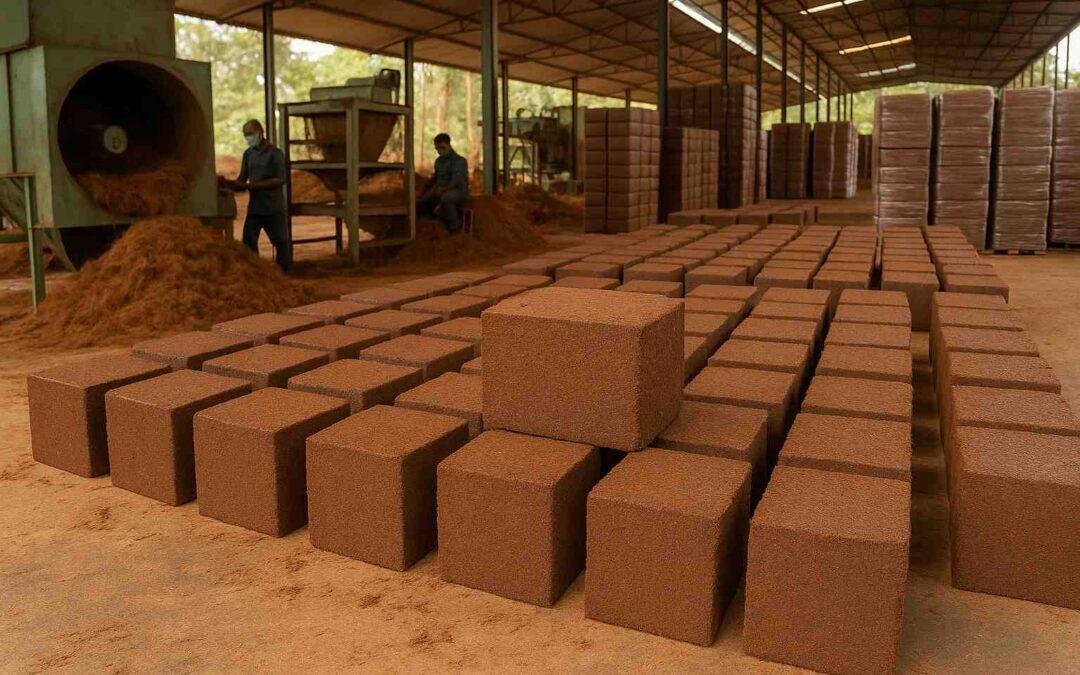
What is Cocopeat? It is a coconut-husk-derived growing medium made from the fine coir material obtained during coconut fibre processing. The coconut husk contains both fibre and a finer pith-like material. After processing, this coir pith can be cleaned, processed, and prepared for use as a growing medium.
Cocopeat is available in different forms depending on its intended application:
- Compressed blocks: Easy to transport and store before hydration.
- Loose cocopeat: Ready for applications where immediate mixing is required.
- Fine-grade cocopeat: Suitable for applications requiring greater moisture retention.
- Coarser grades: Provide additional air spaces and drainage.
- Blended coco media: Combined with other materials for specific crop requirements.
Its natural origin also makes cocopeat an attractive alternative for growers seeking renewable growing-media options.
How Coconut Husk Becomes a Growing Medium
The production process influences the final quality and performance of cocopeat. It is not simply coconut waste collected and placed around plants.
A typical production process involves several stages:
- Husk collection – Suitable coconut husks are selected as the raw material.
- Fibre separation – Machinery separates longer coir fibres from finer coir pith.
- Screening – The material is processed to achieve the required particle structure.
- Washing – Washing helps reduce unwanted soluble salts.
- Buffering – Buffering may be carried out to improve suitability for controlled cultivation.
- Drying and processing – Moisture levels are managed according to product requirements.
- Compression – Selected material can be compressed into blocks for convenient handling.
- Quality checking – Important parameters are assessed before the product reaches growers.
This processing journey explains why two cocopeat products that look similar can perform differently in actual cultivation.
These characteristics make cocopeat useful for both small-scale gardening and larger horticultural operations.
Cocopeat vs Soil: What Is the Difference?
What is Cocopeat compared with traditional garden soil? The two materials have different characteristics and should not automatically be treated as interchangeable.
| Cocopeat | Traditional Soil |
|---|---|
| Derived from coconut husk | Naturally formed mineral and organic material |
| Lightweight | Usually heavier |
| High moisture-holding capability | Moisture retention varies by soil type |
| Provides physical root support | Provides physical and biological support |
| Requires managed nutrition | May naturally contain some nutrients |
| Common in soilless systems | Common in conventional cultivation |
Cocopeat can be used alone in certain systems or combined with other growing materials. The correct choice depends on crop requirements and the cultivation method.
Does Cocopeat Provide Plant Nutrients?
This is an important point for new growers.
Cocopeat should not be treated as a complete fertiliser. Its primary purpose is to provide a suitable physical environment for roots.
Plants require nutrients such as:
- Nitrogen
- Phosphorus
- Potassium
- Calcium
- Magnesium
- Sulphur
- Micronutrients
These nutrients generally need to be supplied through an appropriate fertilisation programme.
This is particularly important in controlled cultivation, where growers have greater control over irrigation and nutrient delivery. A well-managed nutrient programme allows the growing medium to perform its intended physical role without relying on it as the plant’s primary food source.
Why Washing and Buffering Matter
Not all cocopeat is processed in the same way. Coconut-derived material can contain soluble salts and naturally occurring elements that may affect sensitive crops.
Washing helps reduce unwanted soluble components, while buffering can improve the material’s suitability for controlled plant cultivation.
When buying cocopeat, growers should ask suppliers about:
- Washing process
- Buffering process
- Electrical conductivity
- pH range
- Moisture content
- Particle size
- Compression ratio
- Product consistency
For sensitive crops, these specifications can be particularly important during early plant development.
GREGLO supplies processed coco products with a focus on agricultural requirements, including washed and buffered cocopeat options.
How to Choose the Right Cocopeat
The best cocopeat is not necessarily the cheapest or the most visually attractive product. Selection should begin with the intended application.
For Seedlings
Look for a consistent texture with suitable moisture retention and adequate aeration. Excessively coarse or inconsistent material may not be appropriate for delicate root systems.
For Containers
Consider water retention, drainage, particle structure, and the size of the container. The growing medium should support moisture management without remaining excessively wet.
For Commercial Cultivation
Consistency becomes especially important. Growers should evaluate specifications, batch quality, EC, pH, moisture, and processing standards before making large purchases.
For Hydroponic or Soilless Systems
Product specifications become even more important because irrigation and nutrition are carefully controlled. Growers should select material that matches their crop and fertigation strategy.
How to Prepare Cocopeat Before Planting
Compressed cocopeat needs to be hydrated before use. The preparation process is simple but should be carried out carefully.
Step 1: Hydrate the block
Add suitable clean water gradually and allow the compressed material to expand.
Step 2: Break apart the material
Once sufficiently hydrated, loosen the expanded cocopeat and remove compacted sections.
Step 3: Check consistency
Look for an even texture and remove visible unwanted material.
Step 4: Check specifications
Where required, verify pH and electrical conductivity before introducing the material to sensitive crops.
Step 5: Blend if necessary
Depending on the crop, cocopeat can be combined with other suitable growing materials.
Step 6: Establish the nutrient programme
Do not assume the growing medium provides all essential plant nutrients.
Step 7: Test before scaling
For commercial cultivation, trial the product with a smaller crop area before using it across the entire operation.
Common Mistakes Growers Should Avoid
Even a quality growing medium can perform poorly when it is used incorrectly.
- Overwatering
High moisture retention does not mean the medium needs constant irrigation. Excess water can reduce air availability around roots.
- Ignoring EC and pH
These parameters can influence crop performance, particularly for sensitive plants.
- Assuming cocopeat contains sufficient nutrients
Cocopeat provides physical support but should be incorporated into a suitable nutrition programme.
- Buying without checking processing
Ask whether the material has been washed and buffered and whether relevant specifications are available.
- Skipping a trial
Testing a product with the intended crop can reveal how it behaves under local growing conditions.
- Choosing only by price
A lower initial cost may not represent better value if inconsistent material affects crop performance.
Why Product Consistency Matters to Commercial Growers
For large-scale cultivation, consistency can be as important as the basic properties of the growing medium.
A grower may develop an irrigation and nutrient programme based on a specific medium structure. If the next batch behaves very differently, water movement and nutrient management may also change.
Reliable sourcing can therefore help commercial growers maintain greater control over cultivation.
Before placing a bulk order, buyers can request:
- Product specifications
- Sample material
- EC and pH information
- Washing details
- Buffering details
- Particle-size information
- Packaging specifications
- Batch consistency information
At GREGLO, quality-focused processing helps provide cocopeat intended for growers and agricultural buyers who require dependable product characteristics.
What Is Cocopeat Best Used For?
What is Cocopeat best suited for depends on the growing system. Its flexible physical properties allow it to support a broad range of applications.
Common uses include:
- Seed germination
- Nursery propagation
- Potted plants
- Home gardening
- Greenhouse cultivation
- Soilless cultivation
- Hydroponic growing systems
- Commercial horticulture
- Grow bags
- Root-zone applications
The material can also be combined with other growing media when a particular crop requires different levels of drainage, aeration, or moisture retention.
Rather than asking whether cocopeat is universally better than soil, growers should ask whether its characteristics match their crop and cultivation method.
Frequently Asked Questions About Cocopeat
↓
1. What is Cocopeat used for in agriculture?
Cocopeat is used as a growing medium for seedlings, nursery plants, container crops, greenhouse cultivation, soilless systems, and various horticultural applications. It helps create a root environment with useful moisture-retention and aeration characteristics.
2. Can cocopeat replace soil completely?
It can be used as a primary growing medium in certain cultivation systems, but it should not automatically be considered a complete replacement for soil in every situation. Crop requirements, nutrient management, irrigation, and the selected growing system determine whether it should be used alone or blended with other materials.
3. How can growers identify quality cocopeat?
Growers should look beyond appearance and price. Check processing details, washing and buffering, pH, electrical conductivity, moisture, particle structure, cleanliness, and consistency. Requesting product specifications or samples from the supplier can help before purchasing in bulk.
Conclusion
What is Cocopeat is a simple question with a broader answer than just “a coconut-based growing medium.” Its value comes from its structure, moisture management, aeration, renewable origin, and flexibility across different cultivation systems.
For growers, choosing the right product requires attention to processing quality, washing, buffering, pH, EC, particle structure, and crop-specific requirements. Proper preparation and irrigation are equally important for achieving consistent results.
GREGLO focuses on quality-processed coco products for agricultural and horticultural applications, helping growers access cocopeat that is prepared with practical cultivation requirements in mind. With the right product and proper crop management, cocopeat can become a valuable component of modern growing systems.